The Two Ways to Hire Security Guards in the UK
Security guard agencies supply guards on a labour-only basis, often through subcontractors. Direct employers recruit, vet, train, and deploy their own SIA-licensed operatives under a single management structure. The real difference shows in BS 7858 vetting depth, SIA licence verification, incident accountability, and long-term cost. Most UK business owners assume the two models are equivalent — until an insurance claim exposes the gap. Pearl Security is a direct employer of all security guards across Sheffield, Rotherham, Barnsley, Doncaster, and Leeds. Call +44 (0) 7481 153593 to understand which model your insurer actually requires.
Any business supplying or deploying security guards in the UK must comply with the Private Security Industry Act 2001. Both agencies and direct employers require SIA approval. The difference lies in who holds the vetting responsibility, who verifies licences, and who carries the legal liability. Pearl Security SIA Licence: 1014558216157759. Company No: 16175087. All operatives vetted to BS 7858:2019.
Most business owners searching for security guard pricing assume all providers operate the same way. They don’t. The choice between a security guard agency and a directly employing security company affects vetting quality, legal accountability, guard consistency, and the true cost of protection. This guide explains the operational differences, the compliance gaps that insurers care about, and why the cheapest hourly rate often costs more in the long run.
Understanding the two models is essential before you compare quotes. If you are evaluating providers in Sheffield or across South Yorkshire, this is the distinction most sales conversations conveniently skip. For a broader framework on provider selection, see our guide to choosing a security company in Sheffield.
The Two Ways to Hire Security Guards in the UK
The UK private security industry splits into two fundamentally different supply models. The terminology is unregulated — meaning an “agency” and a “company” can look identical on a website — but the operational reality is worlds apart.
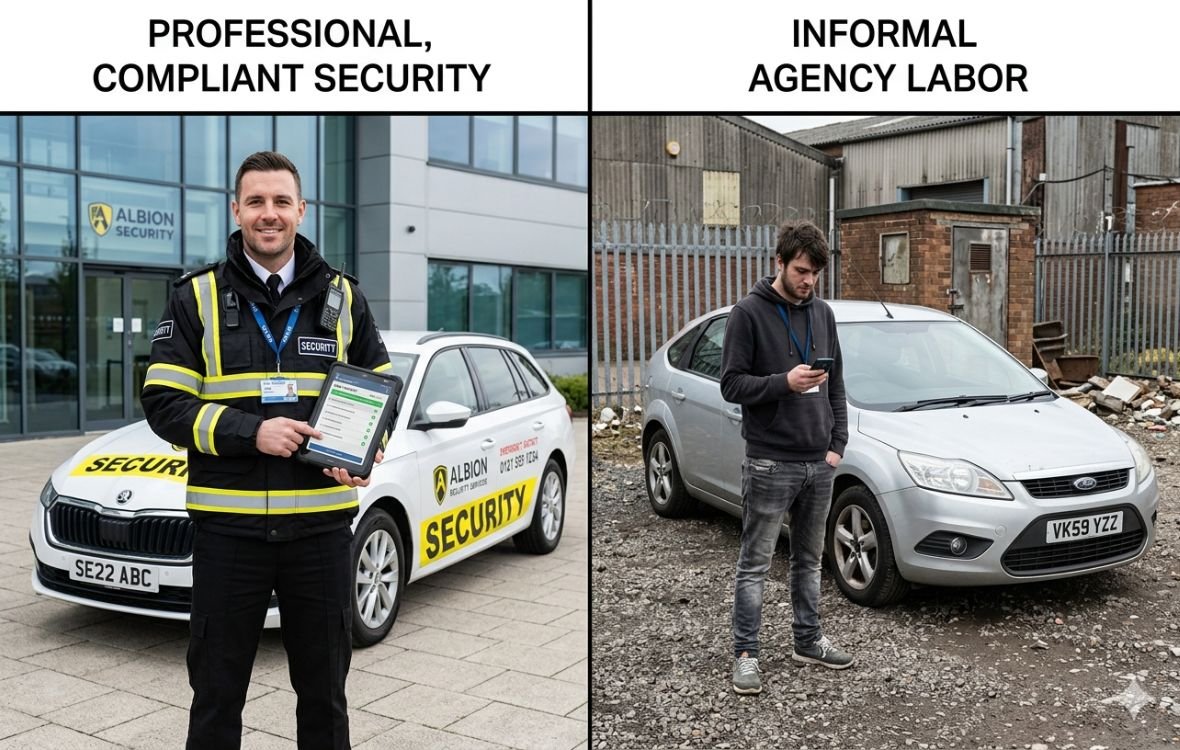
Security guard agency: A labour supplier. The agency recruits guards and places them with end clients, often through a second layer of subcontracting. The agency may not directly employ the guards, may not conduct full BS 7858 vetting in-house, and may supply different operatives each shift. Direct employer security company: A service provider. The company employs every guard directly, conducts all vetting and training internally, and deploys consistent teams under a single management structure. Pearl Security operates exclusively on this model.
The distinction affects everything: who checks the guard’s SIA licence each shift, who holds the vetting file your insurer will demand, and who answers the phone when an incident happens at 2am. Choose the model before you choose the provider.
What Security Guard Agencies Actually Deliver
A security guard agency operates on a labour supply model. The agency’s primary function is recruitment and placement — finding guards and matching them to client sites. Many agencies are entirely legitimate businesses that serve a genuine market need for temporary or flexible cover.
However, the agency model creates inherent structural challenges. When a guard is supplied through an agency, the contractual chain often involves three parties: the guard, the agency, and the end client. If the agency subcontracts — and many do — that chain extends further. Each additional link dilutes accountability.
The agency typically charges the client an hourly rate and pays the guard a lower rate, retaining the difference as their margin. This creates a commercial incentive to minimise the cost of supply — including vetting, training, and supervision. The agency may use self-employed contractors rather than employees, which reduces costs but also reduces control.
From the client’s perspective, the guard who arrives on site may be unknown to the agency’s management team. They may have been vetted by a subcontractor. They may wear a different uniform each shift. If they fail to arrive, the agency may scramble to find a replacement — and the replacement may have no site-specific briefing.
This does not mean agencies are inherently unreliable. It means the model relies on thin margins and rapid placement, which creates risk points that a direct employment model is designed to eliminate.
What Direct Employment by a Security Company Means
A directly employing security company — like Pearl Security in Sheffield — treats every guard as a permanent, employed team member. The company recruits, screens, interviews, and vets each operative. Training is delivered in-house. Supervision is continuous. The guard wears the company’s uniform, follows the company’s documented procedures, and is managed by the company’s supervisory team — not a third-party agency coordinator.
This model costs more to operate, but the quality difference is structural, not aspirational. Because the company bears full legal liability for every guard deployed, its commercial incentive is to invest in thorough vetting, ongoing training, and reliable attendance. A guard who underperforms is not simply replaced from an agency pool — they are managed through the company’s own performance processes.
For the client, this means consistency. The same guards work on the same site. The same management team handles scheduling, incident response, and compliance reporting. When your insurer asks for proof of BS 7858 vetting, the company produces it from its own files — not from a subcontractor who may or may not respond within the required timeframe.
The Real Cost Difference — Where Agency Markups Come From
The hourly rate a security guard agency quotes often appears lower than a direct employer’s rate. That lower rate reflects structural differences in what is included — and what is not. Understanding those differences reveals the true cost comparison.
⚠️ What the hourly rate does not show: Agency quotes typically exclude the cost of supervision, management time, and compliance administration. Direct employers build these into the rate because they are non-negotiable for quality service. The agency’s lower rate may also reflect lower investment in vetting, training, and standby cover — all of which become the client’s problem during an incident or insurance audit.
The cost factors that differ between models include:
- Vetting depth. Direct employers bear the full cost of BS 7858 screening in-house. Agencies may rely on basic right-to-work checks or push vetting responsibility onto subcontractors.
- Standby and contingency cover. A direct employer maintains a standby roster of employed guards. An agency calls around hoping someone is available — and charges a premium for emergency cover if they can supply it at all.
- Management overhead. Direct employers provide dedicated site supervisors and account managers. Agency clients often deal with a centralised coordinator who has never visited the site.
- Insurance and liability. Direct employers carry full public liability and employers’ liability insurance for every guard. In agency chains, liability may be distributed — or disputed — across multiple parties.
- Long-term consistency. The hidden cost of rotating agency guards is lost site knowledge, repeated briefings, and gaps in security that regular guards would have prevented.
For a broader look at how security pricing works across the UK market, see our security company pricing guide. To discuss your specific requirements and get a tailored quote, call +44 (0) 7481 153593.
BS 7858 Vetting — Why the Gap Matters for Your Insurance
BS 7858:2019 is the British Standard for security personnel vetting. It requires a five-year employment and education history check, right-to-work verification, criminal record screening, financial probity assessment, and character references. Your insurer expects every guard on your site to have passed this vetting — and to be able to prove it.
The agency model creates a specific vulnerability here. When an agency subcontracts guard supply, vetting responsibility becomes fragmented. The agency may assume the subcontractor conducted BS 7858 screening. The subcontractor may have conducted only basic checks. The end client — you — receives no direct evidence of vetting. If your insurer audits your security arrangements, you may be unable to produce the documentation they require.
⚠️ Compliance risk: BS 7858 vetting is not a one-time event. It includes ongoing monitoring — right-to-work expiry dates, SIA licence renewals, and refreshed criminal record checks. Direct employers maintain continuous screening as part of employment. Agencies with high guard turnover may not. When your insurer requests a vetting file, a direct employer produces it from their own HR system. An agency may need weeks to assemble documentation from multiple subcontractors — if it can produce it at all.
Pearl Security conducts all BS 7858 vetting in-house. Every guard file is complete, current, and available for client review. No subcontractors. No fragmented responsibility. For guidance on evaluating any provider’s vetting standards, read our buyer’s guide to choosing a security company.
SIA Licence Verification — Who Checks What
Every security guard in the UK must hold a valid SIA licence. The licence must be physically present on the guard’s person and verifiable via the SIA public register at sia.homeoffice.gov.uk. The obligation to verify the licence rests with the organisation deploying the guard.
Here again, the two models diverge. A direct employer verifies every guard’s SIA licence before each deployment as part of its internal compliance process. The licence status is checked against the SIA register, and any issues — such as a licence approaching expiry — are flagged and resolved before the guard is deployed. The company’s management system ensures no guard with an expired or invalid licence ever steps onto a client site.
An agency operating on thin margins may not conduct the same level of verification. Agencies sometimes deploy guards before licence renewals are confirmed, relying on the assumption that the renewal will be processed. If the renewal is delayed or rejected, the client has an unlicensed guard on site — a criminal offence under the Private Security Industry Act 2001, and a direct breach of most commercial insurance policies.
Ask any provider — agency or direct employer — one question before signing: “Can you show me the SIA licence verification record for every guard you intend to deploy, dated today?” The answer will tell you everything you need to know about their compliance culture.
Accountability and Incident Response — The Night Something Goes Wrong
Security incidents rarely happen at convenient times. When an alarm activates, a break-in occurs, or a guard fails to arrive, the strength of your provider’s accountability structure becomes immediately visible.
With a direct employer, a single company carries full responsibility. The guard on site is employed by the company. The supervisor on call is employed by the same company. The manager who will handle the incident report and liaise with your insurer works for the same company. There is no gap between responsibility and authority.
With an agency-supplied guard, accountability is distributed. The guard may be a subcontractor. The supervisor may work for a different subcontractor. The agency coordinator may be in a different city and have no authority over the subcontractor’s operations. When something goes wrong, the client is left chasing multiple parties, none of whom accept full responsibility.
Practical test: Ask any prospective provider to describe — in writing — exactly what happens when a guard fails to arrive for a night shift. A direct employer will describe their standby deployment process: who is called, how quickly a replacement arrives, and how the client is notified. An agency will often describe a “best efforts” process — which means you may be the one making phone calls at midnight.
Read our key holding procedures guide for the full operational standard that applies to every Pearl Security deployment, whether key holding or manned guarding.
Which Model Fits Your Business?
There is no universal answer — only a set of priorities that should guide your decision. Here is a practical framework:
- If your insurer mandates BS 7858 vetting with full documentation: Direct employer. Agencies may not be able to produce complete files on demand.
- If you need the same guards on site consistently: Direct employer. Agencies rotate guards based on availability, not site familiarity.
- If you require rapid incident response and clear accountability: Direct employer. Single-point accountability is faster and cleaner than multi-party chains.
- If you need short-term, flexible cover and accept the compliance trade-offs: Agency may be appropriate — but verify vetting and licensing directly before accepting any deployment.
- If your site is high-risk, high-value, or high-profile: Direct employer. The stakes are too high for fragmented accountability.
For most businesses requiring regular, reliable security in Sheffield and across South Yorkshire, the direct employer model delivers greater accountability, stronger compliance, and better long-term value. See security guard costs in Sheffield for an explanation of what drives pricing in a directly employed model.
International Comparison — How the UK Differs from the USA, Canada, Australia, and New Zealand
The agency vs direct employer debate is not unique to the UK. International businesses seeking UK security should understand how the models compare to what they know at home.
🇺🇸 USA
The US security industry is heavily agency-driven, with many states permitting subcontracting chains. UK direct employment standards — particularly BS 7858 vetting — have no direct US equivalent. US businesses hiring UK security should not assume the agency model they use at home meets UK insurer requirements.
🇨🇦 Canada
Provincial licensing creates a mixed landscape. Large provinces have robust direct employment models, but some smaller provinces rely on agency supply. The UK’s national SIA licensing and BS 7858 standard provide greater consistency than Canada’s provincial system.
🇦🇺 Australia
Australia’s security industry combines agency supply and direct employment. State-based licensing is comparable to the UK SIA, but vetting standards vary. UK BS 7858 is more comprehensive than standard Australian practice, making the direct employer model’s vetting advantage even more significant for UK sites.
🇳🇿 New Zealand
New Zealand’s market is smaller and agency-reliant. The UK’s direct employment model, backed by BS 7858 vetting and SIA licensing, represents a significantly higher standard of accountability than typical New Zealand security supply arrangements.
If you are an international business appointing a UK security provider, the direct employer model is the closest match to the compliance standards your UK insurer expects. For full context on UK manned guarding standards, see our guide to manned guarding security.
Directly Employed Security Guards — Sheffield & South Yorkshire
Pearl Security operates exclusively on the direct employer model. Every guard is our employee — BS 7858 vetted, SIA licensed, and backed by a compliance guarantee. Free consultation on which model satisfies your insurer’s requirements.
FAQs — Security Guard Agencies vs Direct Employers UK
What is the difference between a security guard agency and a direct employer?
A security guard agency supplies guards on a labour basis, often using subcontractors, with variable vetting and supervision. A direct employer security company recruits, vets, trains, and employs its own guards directly — providing full accountability and consistent quality. Learn more in our how to choose a security company guide.
Why do security guard agency rates appear cheaper?
Agency rates may exclude the cost of comprehensive BS 7858 vetting, ongoing supervision, standby cover, and management overhead. The lower rate can reflect lower investment in compliance — which may become the client’s financial and legal risk. Our security pricing guide explains the cost factors in full.
Do security guard agencies carry out BS 7858 vetting?
Some do. Many rely on subcontractors to conduct vetting, creating documentation gaps that insurers will challenge. Direct employers conduct BS 7858 vetting in-house and maintain complete, auditable files. Confirm any provider’s vetting process in writing before signing.
Is one model safer than the other from a compliance perspective?
Yes. The direct employer model provides a single point of accountability for SIA licensing, BS 7858 vetting, and incident management. In an agency chain, responsibility is fragmented — leaving the client exposed during an insurance audit or legal claim.
Can an agency provide the same guard consistently?
Agencies can try, but high turnover and reliance on availability pools make consistency difficult. Direct employers roster employed guards to regular sites, ensuring the same team works the same premises — which builds site knowledge and strengthens security.
How does the UK compare to other countries for security supply models?
The UK’s national SIA licensing and BS 7858 vetting are among the most rigorous globally. US and New Zealand markets are more agency-reliant; Canadian and Australian standards vary by state. UK insurers expect the higher standards that the direct employer model delivers. See international comparison section above.