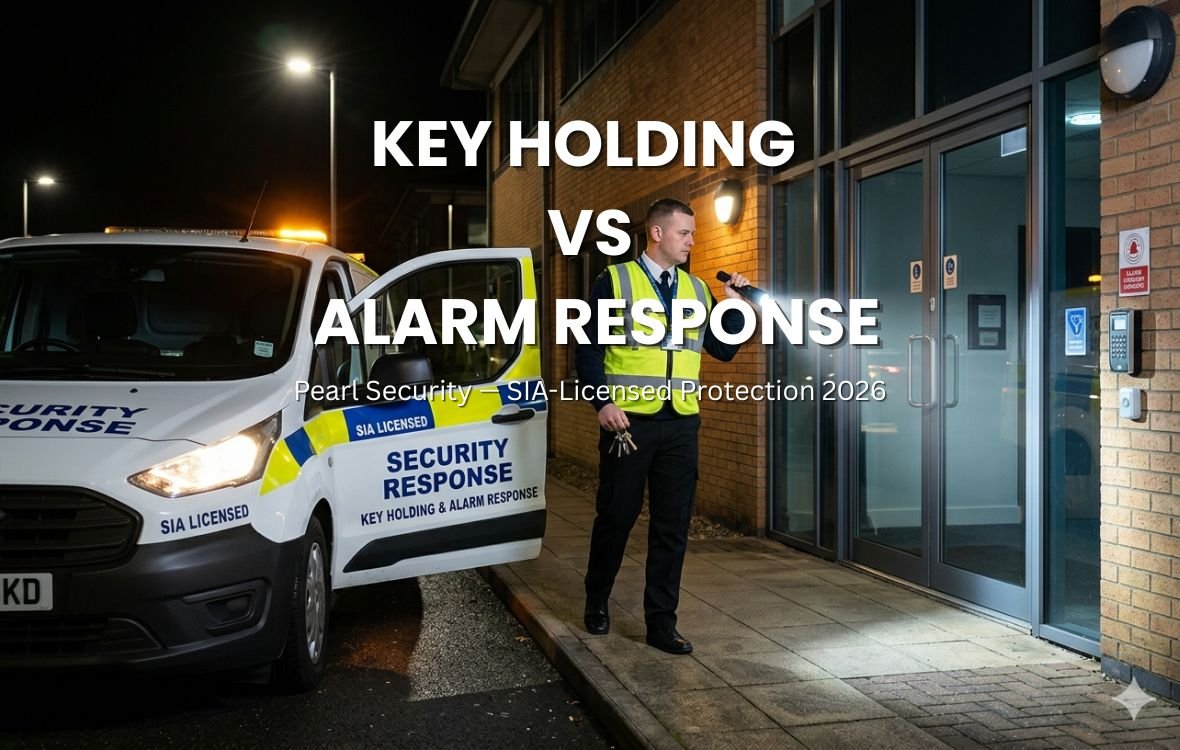
Key Holding and Alarm Response Are Not the Same Service
Key holding is the secure storage of your premises keys by an SIA-licensed provider. Alarm response is the physical attendance at your property when the alarm activates. Most UK businesses need both — but not always. The distinction matters because some insurers mandate one, both, or a specific combination depending on your risk profile, occupancy patterns, and policy wording. Pearl Security provides key holding and alarm response as combined or standalone services across Sheffield, Rotherham, Barnsley, Doncaster, and Leeds. Call +44 (0) 7481 153593 to clarify what your insurer actually requires.
Both key holding and alarm response services in the UK are licensable under the Private Security Industry Act 2001. Any provider offering either service must hold SIA approval and deploy SIA-licensed operatives for alarm attendance. Pearl Security SIA Licence: 1014558216157759. Company No: 16175087. All personnel vetted to BS 7858:2019.
Most business owners use the terms key holding and alarm response interchangeably. They are not the same thing. Confusing them leads to insurance gaps, slower emergency attendance, and a false sense of security that only becomes apparent at 3am when your alarm is sounding and no one is coming.
This guide explains the practical difference, what each service actually delivers, how insurers treat them separately, and how to determine which combination is right for your business. If you are evaluating security providers across South Yorkshire — or reviewing your current arrangement — this is the clarity most companies miss. For foundational context, see our complete guides on what key holding is and professional key holding procedures.
Key Holding and Alarm Response Are Not the Same Service
The confusion is understandable. Both services involve your keys and your alarm. But the distinction is operational, legal, and insurance-critical.
Key holding means a security company securely stores your premises keys, manages access control, and maintains a documented key audit trail. It does not automatically include attending your property when the alarm activates — unless alarm response is explicitly included in the contract. Alarm response means a security company deploys an SIA-licensed officer to your premises when your alarm receiving centre (ARC) notifies them of an activation. It requires key holding as a prerequisite — someone must hold the keys to gain entry — but the two services are contractually and operationally distinct.
Think of key holding as the foundation. Alarm response is the service built on top of it. You can have key holding without alarm response. You cannot have alarm response without key holding. Understanding this hierarchy is essential before you speak to any provider or your insurer.
What Key Holding Alone Actually Delivers
When you engage a provider for key holding only, here is what happens. Pearl Security receives your keys through a formal, documented handover process. Keys are stored in a secure, access-controlled facility with reference codes only — never with identifying information attached, in compliance with UK GDPR and the Data Protection Act 2018. A complete audit trail logs every key movement.
If you lose your keys, need emergency access, or require a contractor to enter out of hours, the key holding provider can facilitate that. Your insurer knows a professional company — not an employee with a set of keys on their kitchen counter — controls access to your premises.
But — and this is where businesses get caught out — key holding alone does not mean anyone attends when your alarm activates. Unless alarm response is specified in your contract, an activation at 2am may go unanswered. Your alarm receiving centre may not even have the key holder’s contact details if the service level is storage-only.
Read our key holding services page for full details on storage standards, GDPR compliance, and coverage across Sheffield, Barnsley, Rotherham, Doncaster, and Leeds.
What Alarm Response Actually Delivers
Alarm response is the active, 24/7 service that kicks in when your monitored alarm system triggers. Your alarm receiving centre contacts the security provider’s dedicated response line. An SIA-licensed officer deploys immediately to your premises — not at some point later, not after business hours resume. Immediately.
The officer conducts an external inspection first — checking for signs of forced entry before using the keys. This protects both officer safety and forensic evidence. If the external check is clear, they enter, disarm the alarm, and conduct a full internal inspection to identify the cause of activation. If there is a break-in, fire, or other emergency, the officer liaises with emergency services, secures the scene, and remains on site until the situation is resolved. The client is notified immediately — regardless of the time — and a written incident report follows.
This is what insurers mean when they require “alarm response.” They do not mean someone checks their phone and decides whether to drive over. They mean a contracted, guaranteed, SIA-licensed physical attendance within a defined timeframe. Without this, your alarm is just a noise complaint. Our key holding procedures guide details the full 11-step response protocol.
Why the Distinction Matters for Your Insurance
UK commercial insurers assess key holding and alarm response as separate risk controls. Some policies require only key holding — secure, professional storage of keys away from the premises. Others mandate full alarm response with a contracted attendance time. Many require both. Assuming one covers the other is a fast track to a rejected claim.
⚠️ Insurance Gap Alert: Check your policy wording. If it states “keys must be held by an SIA-approved professional key holder,” that is key holding. If it states “a professional alarm response service must attend within 20 minutes of activation,” that is alarm response. If it states both — and many do — then key holding alone does not satisfy your policy. Pearl Security’s combined key holding and alarm response service satisfies both requirements in a single contract with unified reporting.
We recommend showing your insurance policy schedule to your security provider before signing. A competent provider will confirm in writing which clauses their service satisfies. If they cannot or will not, find another provider.
Six Questions That Tell You Which Service Your Business Actually Needs
Answer these honestly, and the gap between what you have and what you need becomes visible immediately:
- Is your alarm monitored by an ARC? If no, alarm response is irrelevant — no one is calling anyone. You need physical security and possibly key holding first. See our mobile patrols service for unmonitored premises.
- Does your insurer require alarm response in writing? Check the policy schedule. If yes, key holding alone is insufficient.
- How far away is your nearest key holder? If your current key holder lives 45 minutes from the premises, your insurer’s 20-minute attendance requirement is being breached every single time.
- Is your key holder SIA-licensed? Under the Private Security Industry Act 2001, anyone attending premises for commercial security purposes — including alarm response — requires an SIA licence. A family member, employee, or unlicensed individual does not satisfy this requirement.
- Do you have a single point of failure? If one person holds the keys and that person is on holiday, asleep, or simply misses the call, your alarm activation goes unanswered.
- Are you getting written incident reports after every activation? Insurers require documentation. False alarm or genuine break-in, you need a contemporaneous written report. If you are not getting these, you are not getting professional alarm response.
If you answered “no” or “I don’t know” to any of these, your current arrangement has a gap. Our team at Pearl Security Sheffield can review your policy wording and confirm what you actually need — no charge, no obligation.
How Combined Key Holding and Alarm Response Works in Practice
Here is what the integrated service looks like when Pearl Security provides both:
- Your keys are held in our secure, BS 7858-compliant facility with full audit trail
- Your ARC has our 24/7 dedicated response number on file
- Alarm activates — ARC calls us immediately
- Duty officer assesses activation type and deploys nearest SIA-licensed response officer
- Response officer attends within agreed timeframe — under 30 minutes across our South Yorkshire coverage area
- External inspection first, then internal, cause identified, premises secured
- You are contacted immediately — regardless of time — with outcome
- Written incident report delivered within 24 hours via your client portal
No gaps. No subcontractors. No “we couldn’t get hold of anyone.” Just a single, documented, insurer-compliant process. See our key holding page to book this service across Sheffield, Barnsley, Rotherham, Doncaster, and Leeds.
When Key Holding Alone Is Sufficient
There are scenarios where key holding without alarm response is appropriate — but they are specific and you should confirm with your insurer before proceeding.
Low-risk premises with daytime-only occupancy. A small office with no high-value stock, no cash on site, and an insurance policy that does not require out-of-hours alarm response. Key holding ensures professional key management and emergency access if needed.
Backup key holding for existing in-house arrangements. If your business has staff who act as key holders, a professional key holding service provides redundancy. If the staff member is unavailable, the security company can attend. This is not full alarm response — it is contingency key holding.
Properties where physical patrols already cover alarm verification. If you have contracted mobile patrols at night and the patrol schedule satisfies your insurer’s attendance requirements, standalone key holding may be sufficient. Confirm this with your insurer in writing.
In all other cases, combined key holding and alarm response is the standard insurers expect. If you are unsure, we cover the full range of security cost considerations in our UK security pricing guide.
Why Most Businesses Get This Wrong
The single biggest mistake we see — across Sheffield, across South Yorkshire, across the UK — is business owners who believe their alarm company provides alarm response because they pay for monitoring. Alarm monitoring and alarm response are completely different services.
Monitoring means the ARC watches for activations and notifies someone. Response means someone physically attends. If your monitoring contract does not include a named, contracted key holder with guaranteed attendance, you have monitoring without response. That gap is precisely where insurance claims fail.
The second mistake is assuming a staff member or family member satisfies the insurer’s “professional key holder” requirement. Under the Private Security Industry Act 2001, anyone attending commercially for security purposes must be SIA-licensed. An unlicensed individual — however reliable — does not meet the legal or insurance standard.
Pearl Security’s Sheffield security services include full key holding and alarm response with SIA-licensed officers, digital reporting, and a compliance guarantee for your insurer. Do not discover the gap in your cover at 3am with a sounding alarm and no one on the way.
Key Holding & Alarm Response — Sheffield & South Yorkshire
Pearl Security provides SIA-licensed key holding and 24/7 alarm response as combined or standalone services. Insurer-compliant reporting, response times under 30 minutes. Free review of your insurance requirements.
FAQs — Key Holding vs Alarm Response UK
What is the difference between key holding and alarm response?
Key holding is the secure storage and management of your premises keys by an SIA-licensed provider. Alarm response is the physical attendance at your property when an alarm activates. Key holding is a prerequisite for alarm response, but the services are contractually distinct. Read our full guide: What is Key Holding?
Do I need both key holding and alarm response?
Most UK commercial insurers require both — professional key holding to satisfy key management standards, and contracted alarm response to meet attendance requirements. Check your policy wording for specific obligations. Pearl Security can review your requirements at no charge.
Can my alarm company provide alarm response?
Alarm monitoring companies typically notify a key holder when an alarm activates — they do not send their own response officers. The notification goes to whoever you nominate. If that person is not a contracted, SIA-licensed security provider, the response element of your insurance may not be satisfied. Confirm with your insurer.
Does a staff member with keys satisfy the insurer’s key holding requirement?
In most cases, no. Insurers increasingly require a professional, SIA-licensed key holding provider. Staff-held keys also create single points of failure — illness, holiday, or missed calls leave your premises unresponsive. Our key holding services provide 24/7 guaranteed coverage.
What happens if my alarm activates and I only have key holding?
If your key holding contract does not include alarm response, the provider will not attend. Your ARC may not even contact the key holder if no response service is contracted. This leaves your premises unsecured and your insurance potentially void. Confirm the scope of your service in writing before signing.
How quickly can a key holder attend an alarm activation?
Pearl Security provides alarm response with attendance times under 30 minutes across Sheffield, Rotherham, Barnsley, Doncaster, and Leeds. We also cover Nottingham and surrounding areas. Your insurer may specify a required attendance time — we align our service to meet it.