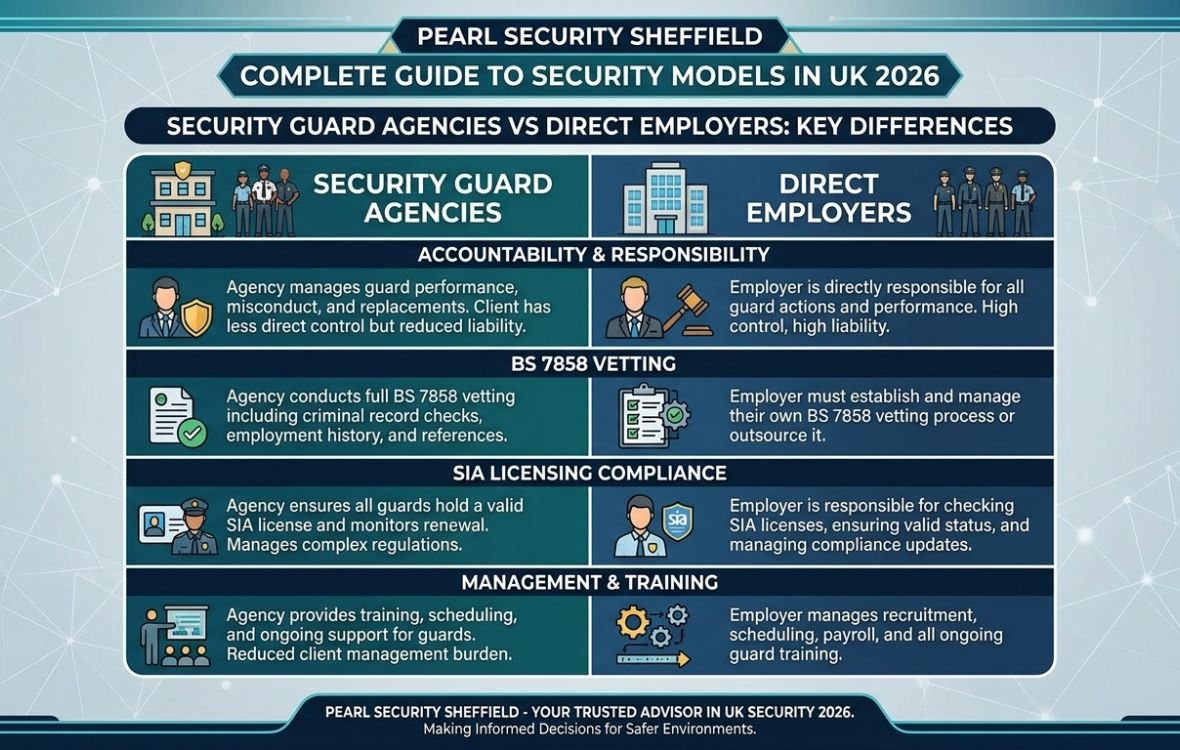
How the Security Guard Agency Model Works
A security guard agency supplies operatives from a pool of workers — often sub-contracted — creating layers between your business and the person protecting your premises. A direct employer like Pearl Security employs all its own officers, manages all vetting directly and gives you a single accountable point of contact. The difference affects compliance, consistency, accountability and the quality of protection your business actually receives. Pearl Security provides directly employed, SIA-licensed security guards across Sheffield, Barnsley, Rotherham, Doncaster, Leeds and Nottingham. Call +44 (0) 7481 153593 for a free consultation.
All Pearl Security operatives are directly employed and hold current, valid SIA licences verified before each deployment. All personnel vetted to BS 7858:2019. ICO Registered: ZB986751. SIA Licence: 1014558216157759. Company No: 16175087. Registered: 249 Barnsley Road, Sheffield, S4 7AD.
You call a security company. They quote you a rate, send you a contract and deploy an officer. Simple. Except — who actually employed that officer? Who vetted them? Who manages them day to day? Who is responsible if something goes wrong?
For most UK businesses, the answer to these questions is murky at best. The security industry has a long history of using agencies, sub-contractors and labour supply chains that make it genuinely difficult for clients to know exactly who is standing in their reception or patrolling their premises at midnight. This guide cuts through that confusion — explaining clearly how the agency model works, why it creates compliance risks and why direct employment delivers better accountability, better vetting and better security for businesses across South Yorkshire.
How the Security Guard Agency Model Works
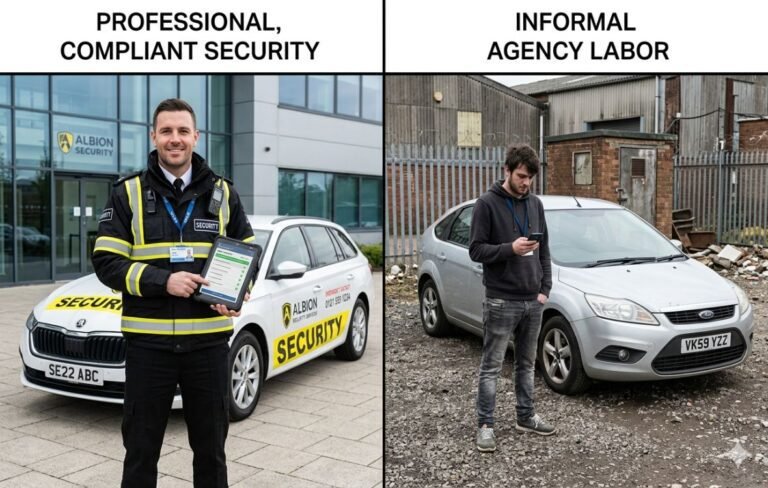
A security guard agency in the UK operates as a labour supplier. The agency takes your contract, marks up the rate and assigns operatives — who may be directly employed by the agency, engaged as self-employed workers or supplied through a further sub-contractor. In some cases, there are two or even three layers between your business and the person deployed to protect your premises.
The agency model is widespread across the UK security industry — particularly among larger national security companies who use regional agencies to fill local contracts quickly. It is not inherently illegal, but it creates a series of compliance and accountability gaps that directly affect the quality of protection your business receives.
Industry context: The UK security industry employs approximately 450,000 SIA-licensed operatives. A significant proportion are engaged through agency arrangements — a practice the Home Office, the Gangmasters and Labour Abuse Authority (GLAA) and the Security Industry Authority have all identified as a risk factor for licensing non-compliance, underpayment and modern slavery exposure across the sector.
Security Guard Agency vs Direct Employer — Full Comparison
| Factor | Security Guard Agency | Direct Employer (Pearl Security) |
|---|---|---|
| Who employs the officer | Agency, sub-contractor or self-employed | Pearl Security directly |
| SIA licence verification | Agency claims to verify — you cannot easily confirm | Verified by Pearl Security before every deployment — you can check independently |
| BS 7858 vetting | Agency claims to vet — difficult to confirm independently | Completed by Pearl Security — confirmed in writing on request |
| Accountability | Shared across agency, sub-contractor and client | Single point — Pearl Security |
| Officer consistency | Variable — different officers deployed without notice | Managed operatives — consistent deployment |
| Management contact | Often national call centre — no local knowledge | Direct Sheffield management contact — local and available |
| Modern slavery risk | Higher — multiple supply chain layers | Lower — direct employment, transparent pay |
| Working Time compliance | Difficult to monitor across multiple engagements | Managed directly — full Working Time Regulations compliance |
| Insurance clarity | May be unclear which entity’s insurance applies | Pearl Security’s public and employer’s liability — clear and confirmed |
The BS 7858:2019 Vetting Problem With Agencies
This is the most serious practical risk of the agency model — and the one most businesses never think to ask about.
Under BS 7858:2019, every security operative should be vetted to the British Standard before deployment — covering 5-year employment history, DBS criminal record checks, identity verification and credit checks. In a direct employment model, the company deploying the officer is responsible for that vetting and can demonstrate it.
In the agency model, vetting responsibility often falls to the agency or sub-contractor. Your security contract is with the company you called — but the officer protecting your premises was vetted by an organisation you have never dealt with and cannot directly audit. You have no practical way of confirming that BS 7858:2019 vetting was completed to the required standard.
Pearl Security vets every operative directly to BS 7858:2019 before any deployment across Sheffield and South Yorkshire — and confirms this in writing on request. One company. One vetting standard. Complete accountability.
The SIA Licensing Problem With Agencies
SIA licence verification sounds simple — check the licence is valid at sia.homeoffice.gov.uk. In a direct employment model, the company deploying the officer verifies that licence and can provide the licence number for you to check independently.
In the agency model, SIA licence verification sits with the agency or sub-contractor. If an operative is deployed with an expired, suspended or invalid licence — something that does happen across the industry — your business may not know until an incident occurs. Under the Private Security Industry Act 2001, both the security company and your business can face consequences if unlicensed operatives are found working on your premises.
⚠️ Real Risk: The Security Industry Authority conducts regular enforcement operations across the UK — including in South Yorkshire — targeting businesses using unlicensed security operatives. If an unlicensed officer is found on your premises, your business faces potential prosecution regardless of whether the licence failure was the agency’s fault. Always verify SIA licences independently at sia.homeoffice.gov.uk. Pearl Security SIA Licence: 1014558216157759.
Working Time Regulations — The Agency Compliance Gap
Security officers working through agencies frequently work for multiple clients across multiple engagements — making compliance with the Working Time Regulations 1998 genuinely difficult to monitor. An officer working 12-hour overnight shifts for an agency, supplementing income with additional shifts through a second agency, may be working far in excess of legal limits — and neither agency has the full picture.
Fatigue is a genuine safety risk in security operations. An exhausted officer working an overnight shift after an excessive number of consecutive working days is not providing effective security — and represents a liability for your business. Pearl Security manages all its officers directly — monitoring working hours, managing shift patterns and ensuring full compliance with Working Time Regulations for every operative deployed across South Yorkshire.
Modern Slavery and Ethical Employment — Agency Supply Chains
The Home Office, GLAA and SIA have all identified the security industry as a sector at elevated risk of modern slavery and labour exploitation — particularly within agency supply chains. Multiple layers of sub-contracting make it difficult to verify that operatives at the end of the supply chain are being paid fairly, working lawfully and not subject to exploitation.
Pearl Security directly employs all its officers, pays at least the National Living Wage, provides written employment contracts before the first shift and maintains full compliance with the Modern Slavery Act 2015. See our Modern Slavery Policy.
When Might an Agency Be Appropriate?
The agency model is not always wrong. There are specific circumstances where using a security agency makes practical sense:
- Large national contracts requiring simultaneous deployment across multiple regions — where no single direct employer has the geographic reach
- Short-notice, one-off event security where rapid deployment from an agency pool is genuinely necessary
- Supplementary cover for unexpected absences on an existing direct employment contract
For most South Yorkshire businesses requiring ongoing manned guarding, mobile patrols or key holding — a direct employer delivers better compliance, better consistency and better accountability at no meaningful additional cost.
Questions to Ask Any Security Provider Before Signing
- Are the officers who will be deployed directly employed by your company?
- Who is responsible for BS 7858:2019 vetting — can you confirm it in writing?
- Can you provide SIA licence numbers for all officers before deployment?
- Who manages the officers day to day — your company or a third party?
- Who holds public liability insurance — your company or an agency?
- How do you ensure Working Time Regulations compliance for all deployed officers?
- What is your Modern Slavery policy — can I see it?
- Who is the local management contact for my contract?
Pearl Security answers every one of these questions clearly and in writing — before any contract is signed across Sheffield and South Yorkshire. See our full buyer’s guide: How to Choose a Security Company UK.
✅ Pearl Security — Direct Employer, Single Accountability: Pearl Security directly employs all security officers deployed across Sheffield, Barnsley, Rotherham, Doncaster, Leeds and Nottingham. All officers SIA-licensed, BS 7858 vetted, Working Time compliant, directly managed. No agencies. No sub-contractors. One accountable provider. Call +44 (0) 7481 153593 or request a free consultation.
Direct, Accountable Security — South Yorkshire & East Midlands
Pearl Security provides directly employed, SIA-licensed security across Sheffield, Barnsley, Rotherham, Doncaster, Leeds and Nottingham. No agencies. No sub-contractors. Free consultation available.
FAQs — Security Guard Agencies vs Direct Employers UK
What is the difference between a security agency and a direct employer?
A security agency supplies operatives from a pool of workers — often sub-contracted — creating multiple layers between your business and the deployed officer. A direct employer like Pearl Security employs all its own officers, manages all vetting and provides a single accountable point of contact for every deployment.
Are security guard agencies legal in the UK?
Yes — security agencies are legal in the UK. All operatives must hold valid SIA licences under the Private Security Industry Act 2001 regardless of their employment model. The issue is not legality but accountability — the agency model creates compliance and vetting gaps that directly affect service quality.
Who is responsible for BS 7858 vetting in an agency arrangement?
In theory, the agency or sub-contractor deploying the operative is responsible for BS 7858:2019 vetting. In practice, vetting responsibility is often unclear across multiple supply chain layers — making independent verification difficult for clients. Pearl Security vets all officers directly and confirms this in writing on request.
Does Pearl Security use agencies or sub-contractors?
No — Pearl Security directly employs all security officers deployed across Sheffield, Barnsley, Rotherham, Doncaster, Leeds and Nottingham. No agencies. No sub-contractors. Every officer is vetted, licensed and managed directly by Pearl Security.
Can my business be liable if an agency deploys an unlicensed officer?
Yes — under the Private Security Industry Act 2001, businesses using unlicensed security operatives on their premises can face consequences regardless of whether the licence failure was the agency’s responsibility. Always verify SIA licences independently at sia.homeoffice.gov.uk before any officer begins work on your premises.