Retail Security Guards UK — Loss Prevention, Legal Powers & How to Hire (2026)
Retail security guards in the UK are SIA-licensed operatives trained in loss prevention, shoplifting deterrence, organised retail crime identification, lawful detention under Section 24A PACE 1984 and Equality Act 2010 compliance. UK retail theft cost businesses £1.8 billion in 2023 — and rising. Pearl Security provides professional retail security guards across Sheffield, Barnsley, Rotherham, Doncaster, Leeds and Nottingham — SIA-licensed, BS 7858 vetted, directly employed. Call +44 (0) 7481 153593 for a free retail security assessment.
Retail security officers in the UK must hold a valid SIA Security Guard licence under the Private Security Industry Act 2001. All detention decisions must comply with Section 24A of the Police and Criminal Evidence Act 1984. All access control and customer interaction decisions must comply with the Equality Act 2010. Pearl Security SIA Licence: 1014558216157759. Company No: 16175087. ICO: ZB986751.
Retail theft in the UK is not a minor inconvenience. It is an organised, professional criminal activity that costs the retail sector billions every year — and the picture has got significantly worse since 2020. Organised retail crime gangs operate across South Yorkshire, targeting everything from high-street fashion stores and supermarkets to trade counters and independent retailers. The difference between a retailer who manages shrinkage effectively and one whose margins are being eaten alive is often a single decision: whether to deploy professional retail security or rely on CCTV and hope.
This guide explains what retail security guards actually do in the UK, what legal powers they hold, what they cannot lawfully do, how much professional retail security costs and how to choose the right provider for your South Yorkshire retail business — or for international retailers establishing UK operations.
What is Retail Security? The Real Job Behind the Uniform
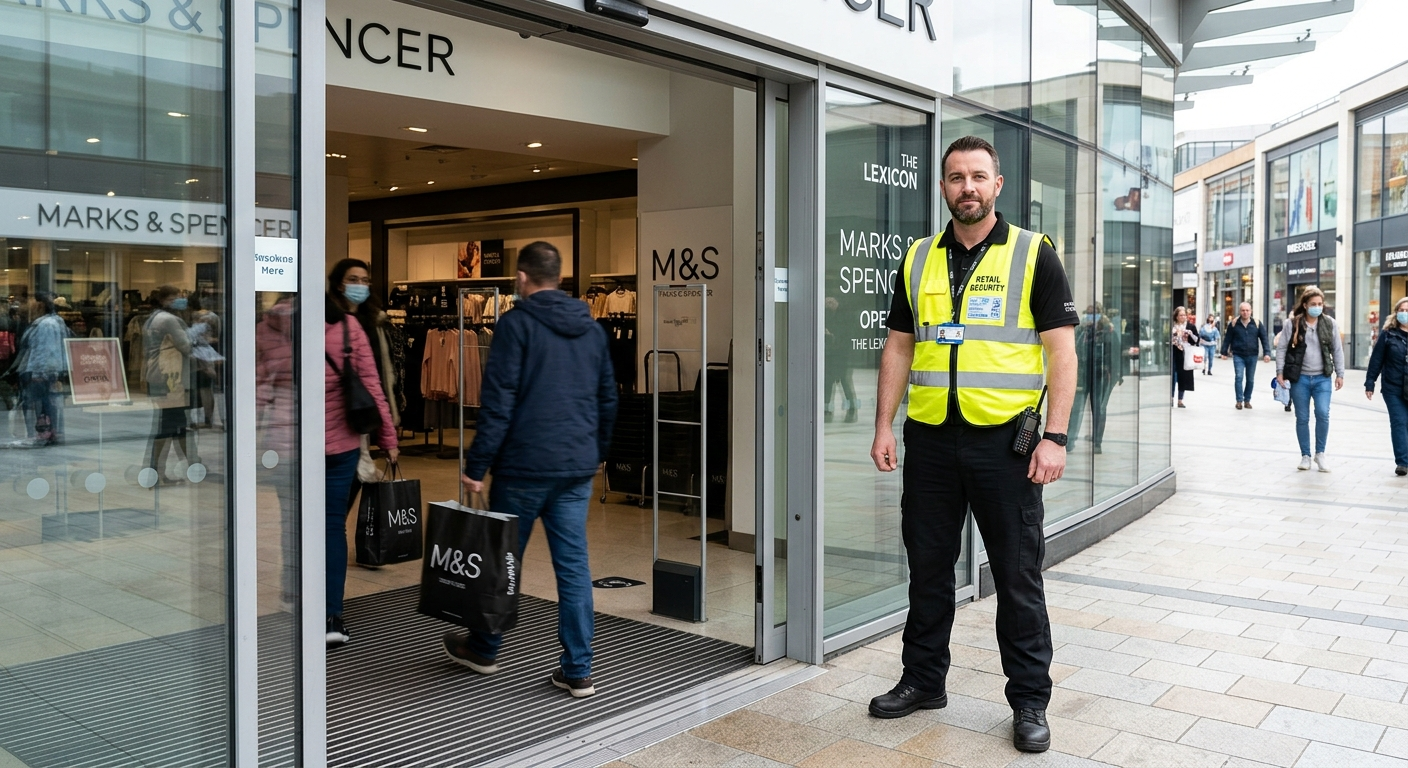
A retail security officer is not a deterrent ornament standing by the door. A professional retail security officer is a trained loss prevention operative whose role covers a specific and legally defined set of duties — all conducted within a framework that balances the security needs of the business against the rights of customers and staff.
The best retail security officers are almost invisible to the honest customer. They are professional, courteous and unobtrusive — managing the retail environment without creating the kind of confrontational atmosphere that damages the customer experience and, ultimately, the retailer’s reputation. The visible deterrence effect comes from presence and professionalism, not aggression.
What actually happens in a professional retail security deployment across a South Yorkshire store:
- Entrance observation — identifying pre-theft behaviour at the point of entry. Experienced retail security officers recognise the specific behavioural patterns that precede shoplifting attempts — nervous glancing, selective browsing in high-value areas, unusual clothing for the weather, coordination between multiple individuals. This observation starts at the door, not at the till.
- Floor monitoring — systematic movement through the retail environment — not random wandering — designed to provide visible deterrence across all areas and maintain observation of individuals displaying pre-theft behaviour.
- Organised retail crime identification — recognising the patterns of organised retail crime gangs, which operate very differently from opportunistic shoplifters. ORC involves multiple individuals, rehearsed concealment methods, counter-surveillance behaviour and coordinated distraction techniques. Identifying ORC requires specific training and experience.
- Lawful detention — where reasonable grounds exist to believe an indictable offence has been committed, detaining the individual under citizen’s arrest powers until police arrive. This must be handled correctly — both legally and professionally.
- Incident documentation — written incident reports after every security event, suitable for police evidence and insurance purposes.
- Staff safety — retail security officers provide an additional layer of protection for staff in high-pressure situations — customer confrontations, aggressive behaviour and distressing incidents involving vulnerable individuals.
UK Retail Theft — The Scale of the Problem in 2026
UK retail crime statistics make uncomfortable reading for any retail business owner. The British Retail Consortium’s annual retail crime survey consistently identifies retail theft as the primary profit threat facing UK retailers — and the 2023 figures showed the problem accelerating rather than stabilising.
In South Yorkshire specifically, the retail crime picture reflects national trends amplified by the economic pressures on the region. Sheffield city centre, Meadowhall, Rotherham town centre, Barnsley’s Alhambra precinct and Doncaster’s Frenchgate all face consistent retail crime pressure — from opportunistic individual theft through to coordinated organised retail crime operations targeting high-value merchandise.
UK Retail Crime Context — 2023/2024: The British Retail Consortium reported retail theft incidents rising year on year, with customer theft accounting for the largest share of shrinkage. Organised retail crime — gangs targeting multiple stores with coordinated theft operations — accounts for a disproportionate share of the total value stolen. Professional retail security is the most effective deterrent against both opportunistic and organised retail crime. CCTV alone does not prevent theft — it records it.
What Retail Security Guards Can and Cannot Do in the UK
Understanding the legal powers of a UK retail security officer is essential — both for the retailers who hire them and for the officers themselves. Getting this wrong creates significant legal and reputational risk for your business.
What Retail Security Officers Can Do
- Observe and monitor — retail security officers can observe any person in the retail environment and make judgements about behaviour based on that observation.
- Request to search — retail security officers can request a customer’s voluntary consent to search bags or clothing. They cannot compel a search without consent. Where bag searches are a standard condition of entry — displayed clearly at the entrance — customers who voluntarily enter the store have implicitly consented.
- Detain under citizen’s arrest powers — where there are reasonable grounds to believe an indictable offence has been committed, Section 24A PACE 1984 permits detention until police arrive. The officer must have witnessed the theft directly — acting on suspicion alone is insufficient and creates civil and criminal liability.
- Refuse entry — as agents of the store occupier, retail security officers can refuse entry to any individual — provided the refusal does not breach the Equality Act 2010.
- Use reasonable force — in self-defence or defence of another, retail security officers can use reasonable force under the Criminal Law Act 1967. Force used must be proportionate to the threat.
What Retail Security Officers Cannot Do
- Search without consent — no statutory power to search any person without their voluntary agreement
- Detain on suspicion alone — the indictable offence must have been committed, not merely suspected
- Discriminate — all retail security decisions must comply with the Equality Act 2010. Refusing entry or treating customers differently on the basis of any protected characteristic is unlawful — regardless of any business justification offered
- Use excessive force — force disproportionate to the situation creates both criminal and civil liability for the officer and the retailer
- Issue fixed penalty notices — a police power. Retail security officers have no authority to issue fines.
⚠️ Equality Act 2010 Compliance — Non-Negotiable: Every retail security decision — who to approach, who to observe, who to refuse entry — must comply with the Equality Act 2010. Profiling customers based on race, age, disability or any other protected characteristic is unlawful and exposes your business to significant legal and reputational risk. Pearl Security trains all retail security officers in Equality Act compliance before deployment and maintains this training throughout employment. A security incident handled incorrectly can cost significantly more than the theft it was meant to prevent.
Types of Retail Security Deployment in the UK
Uniformed Retail Security Officers
The standard retail security deployment — a uniformed, SIA-licensed officer providing visible deterrence on the retail floor. Uniformed presence is the most effective deterrent against opportunistic shoplifting and provides the most visible reassurance for customers and staff. Pearl Security provides uniformed retail security officers across all South Yorkshire retail environments.
Plain-Clothes Loss Prevention Officers
Plain-clothes retail security operatives work without visible uniform — observing the retail environment as apparently ordinary customers. Plain-clothes deployment is particularly effective against organised retail crime gangs, who conduct counter-surveillance checks specifically to identify uniformed security before committing theft. Effective loss prevention programmes combine both uniformed and plain-clothes presence.
Retail Security with Reception and Front-of-House Duties
For larger retail environments — department stores, trade showrooms, high-value independent retailers — retail security officers provide a combined function covering loss prevention, visitor management, customer service and access control. This front-of-house retail security model is increasingly common across Sheffield’s high-value retail and trade counter sector.
Out-of-Hours Retail Security
For retail premises between closing time and opening the following morning, mobile security patrols and key holding and alarm response provide cost-effective out-of-hours protection. After the retail team leaves, the risk profile changes — from shoplifting to burglary and criminal damage. Pearl Security provides seamless cover across both the trading day and the out-of-hours period.
How Much Do Retail Security Guards Cost in the UK? (2026)
Retail security costs depend on the hours required, the number of officers deployed and the specific risk profile of the retail environment. Realistic 2026 market rates for professional, SIA-licensed retail security across South Yorkshire:
| Deployment Type | South Yorkshire Rate | London / South East Rate |
|---|---|---|
| Uniformed retail guard — trading hours | £14 to £18 per hour | £22 to £30 per hour |
| Plain-clothes loss prevention | £16 to £20 per hour | £24 to £35 per hour |
| Out-of-hours mobile patrols | From £80 per month | From £150 per month |
| Key holding and alarm response | From £50 per month | From £100 per month |
The ROI calculation for retail security is straightforward. If a single retail security officer on a full trading-day shift prevents £300 of theft that would otherwise have occurred — and retail crime data suggests organised retail crime operations regularly exceed this per visit — the officer’s cost is covered by the loss prevention alone, before accounting for insurance implications, staff welfare and the deterrence effect on future targeting.
See our full pricing guide: How Much Do Security Companies Charge Per Hour UK?
Retail Security — South Yorkshire Coverage
Retail Security Sheffield
Sheffield’s retail security market covers Fargate and The Moor town centre, Meadowhall shopping centre corridor, Crystal Peaks, Hillsborough retail area and the growing independent retail sector across Ecclesall Road and Kelham Island. Pearl Security provides retail security officers across all Sheffield retail environments — from national brands to independent specialists. See our Sheffield security page.
Retail Security Barnsley
The Alhambra Shopping Centre, Barnsley town centre market and high street, and the retail parks on the M1 corridor. Barnsley retail crime data consistently places the town centre among the higher-risk retail environments in South Yorkshire. Professional retail security is the most cost-effective response. See our Barnsley security page.
Retail Security Rotherham
Parkgate Retail Park — one of South Yorkshire’s largest out-of-town retail destinations — Rotherham town centre and the surrounding retail corridor. See our Rotherham security page.
Retail Security Doncaster
Frenchgate Shopping Centre, Doncaster town centre and the retail parks along the M18 corridor. See our Doncaster security page.
Retail Security Leeds
Leeds city centre retail — Trinity Leeds, Victoria Gate, Briggate — and the retail parks across the Leeds metropolitan area. See our Leeds security page.
Choosing a Retail Security Provider — What to Check
- All officers hold valid SIA Security Guard licences — verified at sia.homeoffice.gov.uk before deployment
- All officers vetted to BS 7858:2019 — confirmed in writing
- Equality Act 2010 training completed and documented before retail deployment
- PACE 1984 Section 24A detention training confirmed — officers must understand exactly what justifies lawful detention
- Conflict management training confirmed — retail environments involve confrontational situations that require professional de-escalation skills
- Written incident reports provided after every security event
- Public liability insurance confirmed — certificate available on request
- Direct employer confirmed — not an agency supplying sub-contracted operatives
- Named management contact for your contract — not a national call centre
- Experience of retail environments confirmed — retail security requires specific training and operational experience
Retail Security for International Businesses Operating in the UK
For retailers based in the USA, Canada, Australia or New Zealand operating UK stores, the UK retail security framework differs from home markets in several important ways:
- SIA licensing is mandatory — every retail security officer must hold a valid SIA Security Guard licence. There are no exceptions, and there is no equivalent to the state-by-state variation seen in the USA.
- No armed retail security — UK retail security officers are unarmed. Armed retail security does not exist in standard UK retail environments.
- Equality Act 2010 applies strictly — the UK Equality Act is broadly comparable in intent to Title VII (USA) and equivalent Australian and Canadian legislation, but the specific application in retail security contexts has UK-specific characteristics. All retail security training must cover UK Equality Act compliance specifically.
- Detention powers are limited — UK retail security officers rely on citizen’s arrest powers under PACE 1984. The standard of proof required for lawful detention — reasonable grounds that an indictable offence has been committed — is specific to UK law.
✅ Pearl Security Retail Security — South Yorkshire: Professional, SIA-licensed retail security guards across Sheffield, Barnsley, Rotherham, Doncaster and Leeds. Uniformed and plain-clothes deployment, Equality Act trained, PACE 1984 compliant, directly employed with no agency layers. Call +44 (0) 7481 153593 or request a free retail security assessment online.
Retail Security Guards — South Yorkshire & East Midlands
Pearl Security provides SIA-licensed retail security across Sheffield, Barnsley, Rotherham, Doncaster and Leeds. Free retail security assessment — no obligation.
FAQs — Retail Security Guards UK
Do retail security guards need SIA licences in the UK?
Yes — every retail security guard working commercially in the UK must hold a valid SIA Security Guard licence under the Private Security Industry Act 2001. Verify all licences at sia.homeoffice.gov.uk before deployment. Pearl Security SIA Licence: 1014558216157759.
Can a retail security guard detain a shoplifter in the UK?
Yes — where there are reasonable grounds to believe an indictable offence has been committed, a retail security officer can detain an individual under citizen’s arrest powers under Section 24A of the Police and Criminal Evidence Act 1984. The officer must have directly witnessed the theft — acting on suspicion alone is insufficient and creates liability. Pearl Security trains all retail security officers in lawful detention procedures before deployment.
Can retail security guards search customers in the UK?
Only with the customer’s voluntary consent. UK retail security officers have no statutory power to search any person without consent. Bag searches at the store entrance are permissible where customers have been clearly notified and voluntarily enter — this constitutes implied consent. Compelled searches without consent are unlawful.
How much does retail security cost in the UK?
SIA-licensed retail security officers cost £14 to £18 per hour for standard trading-hour deployments across South Yorkshire. London rates are significantly higher at £22 to £30 per hour. See our full pricing guide: How Much Do Security Companies Charge Per Hour UK?
What is the difference between a retail security guard and a loss prevention officer?
In UK practice, retail security guard and loss prevention officer describe the same SIA-licensed role — a trained operative providing theft deterrence, customer monitoring and lawful detention capability in a retail environment. Loss prevention is the American term more commonly used in UK retail by international brands. Both require the same SIA Security Guard licence under UK law.
Do you provide retail security in Barnsley and Rotherham?
Yes — Pearl Security provides professional retail security guards across Barnsley — including the Alhambra Shopping Centre and town centre — and Rotherham — including Parkgate Retail Park and town centre. See our Barnsley and Rotherham security pages for full coverage details.