UK Security Threat Levels Explained — What They Mean for Your Business (2026)
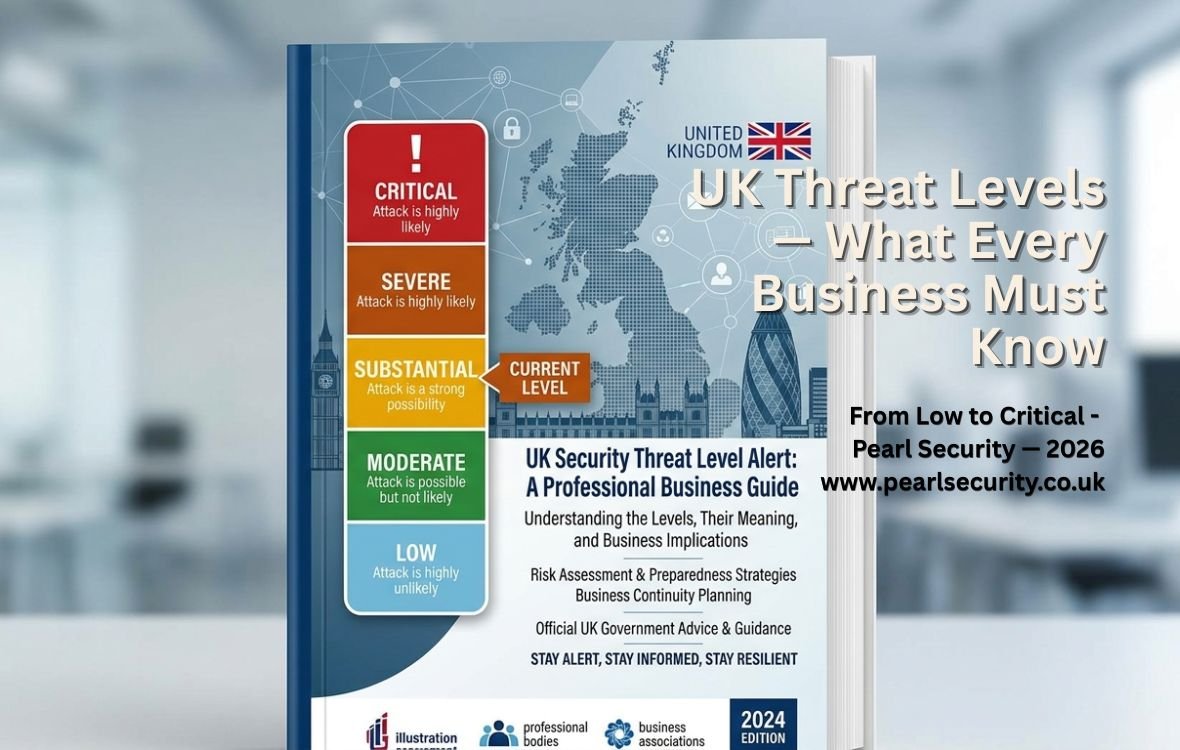
The UK operates a five-tier national security threat level system managed by MI5 and the Joint Terrorism Analysis Centre (JTAC). The five levels are: Low, Moderate, Substantial, Severe and Critical. As of 2026, the UK terrorism threat level is Substantial — meaning an attack is likely. Threat levels are set independently for international terrorism and Northern Ireland-related terrorism. Businesses can check the current UK threat level at mi5.gov.uk/threat-levels. Pearl Security provides professional manned guarding, mobile patrols and alarm response across South Yorkshire and the East Midlands to help businesses maintain appropriate security measures at all threat levels.
This guide is based on publicly available information from MI5, the Home Office, the Centre for the Protection of National Infrastructure (CPNI) and the National Counter Terrorism Security Office (NaCTSO). Threat level information is updated by government agencies and may change. Always check the current threat level at mi5.gov.uk. Pearl Security SIA Licence: 1014558216157759. Company No: 16175087.
Most UK business owners are aware that terrorism threat levels exist. Far fewer understand what they actually mean in practice — how they are set, what each level implies for day-to-day operations and what a responsible business should do differently when the threat level rises. This guide answers all of those questions clearly and practically.
Understanding the UK security threat level system is not just relevant for large corporations or public sector organisations. Small and medium-sized businesses across Sheffield, Leeds, Doncaster and South Yorkshire have the same responsibility to maintain appropriate, proportionate security measures — and the same vulnerability when they do not. Pearl Security provides professional, SIA-licensed security services that help businesses maintain effective protection at every threat level.
What is the UK Security Threat Level System?
The UK national security threat level system is a five-tier scale that communicates the likelihood of a terrorist attack against the UK. It is set and maintained by the Joint Terrorism Analysis Centre (JTAC) — a cross-government body hosted by MI5 — based on available intelligence, current capability of terrorist groups and indications of intent to attack.
The threat level system was introduced in its current five-tier form in August 2006, replacing an earlier four-tier system. It provides a consistent, publicly communicated benchmark that allows government, law enforcement, businesses and the public to calibrate their security response appropriately.
Two separate threat levels are published:
- International terrorism threat level — the threat to the UK from international terrorism, including Islamist extremism and other internationally-directed threats
- Northern Ireland-related terrorism threat level — the threat from terrorism connected to the situation in Northern Ireland, set by the Security Service
The current threat levels are always published at mi5.gov.uk/threat-levels.
The Five UK Threat Levels — Explained
An attack is highly likely in the near future. This is the highest threat level and is only reached when intelligence indicates an attack is imminent. At Critical level, government and security services activate the highest state of readiness. Businesses should review all security measures, increase visible deterrence and ensure all staff are briefed on security and evacuation procedures.
An attack is highly likely. Severe is the second-highest level. It indicates a high probability of an attack without necessarily implying an imminent specific plot. UK threat level has been at Severe for extended periods in recent years. Businesses in high-footfall environments — retail, transport, hospitality — should maintain enhanced security measures continuously at this level.
An attack is likely. Substantial is the current UK threat level as of 2026 for international terrorism. This is the middle tier — indicating that an attack is a genuine possibility based on available intelligence. For most UK businesses, Substantial represents the baseline security planning level. Professional manned guarding, access control and alarm response are appropriate and proportionate measures at this level.
An attack is possible but not likely. Moderate indicates a lower probability of attack. Standard security measures remain appropriate. Businesses should maintain their baseline security posture without necessarily implementing enhanced measures.
An attack is highly unlikely. Low is the minimum threat level. It does not mean zero risk — no threat level ever implies complete absence of risk. Standard security good practice remains relevant at Low level. The UK threat level has rarely been at Low in the post-2001 era.
Who Sets the UK Threat Level?
The Joint Terrorism Analysis Centre (JTAC) sets and reviews the international terrorism threat level. JTAC was established in 2003 and is hosted within MI5 at Thames House, London. It draws on intelligence from MI5, MI6 (Secret Intelligence Service), GCHQ, the Defence Intelligence Staff and other government agencies.
The Northern Ireland threat level is set separately by the Security Service (MI5) in consultation with the Police Service of Northern Ireland (PSNI) and other relevant agencies.
Threat levels are reviewed continuously and can be changed at any time based on new intelligence. Changes are announced publicly through the Home Office and MI5 websites. There is no fixed schedule for reviews — they occur when intelligence warrants a reassessment.
Current UK Threat Level (2026)
As of 2026, the UK terrorism threat level for international terrorism is Substantial — meaning an attack is likely. The UK has maintained a Substantial or higher threat level for the majority of the past decade, reflecting the persistent and evolving nature of terrorism threats facing the country.
For the most current and accurate threat level information always check the official source: mi5.gov.uk/threat-levels. Pearl Security monitors threat level changes and provides guidance to clients across South Yorkshire and the East Midlands on appropriate security responses.
Important context: The UK terrorism threat level relates specifically to the threat of terrorist attack. It is distinct from general commercial crime threats — burglary, theft, vandalism — which are governed by local crime statistics rather than the national threat level system. Both dimensions of risk are relevant for UK businesses when planning their security arrangements. See our guide to the UK security market in 2026 for broader commercial crime context.
What the UK Threat Level Means for Businesses
The UK threat level system is designed primarily to guide government, law enforcement and critical national infrastructure. However, it has direct relevance for UK businesses — particularly those operating in high-footfall environments, managing large numbers of staff or visitors, or occupying premises in city centres and major commercial districts.
At Substantial Level — Current (2026)
At Substantial, an attack is considered likely. This does not mean businesses should operate in a constant state of alert — but it does mean that professional, proportionate security measures are appropriate and justified. For most South Yorkshire businesses, this means:
- Maintaining professional access control — knowing who is on your premises at all times
- Ensuring alarm systems are monitored and professionally responded to via key holding and alarm response
- Briefing staff on security awareness — suspicious packages, unusual behaviour, evacuation procedures
- Reviewing perimeter security — fencing, lighting, CCTV coverage, access points
- Maintaining visible security presence where appropriate — particularly in retail and high-footfall environments
At Severe Level — Enhanced Measures
If the threat level rises to Severe, businesses — particularly those in retail, hospitality, transport and public-facing roles — should consider enhanced measures:
- Increasing visible uniformed security presence via manned guarding
- Implementing enhanced bag searches and access control at entry points
- Increasing frequency of mobile security patrols around premises
- Reviewing and rehearsing evacuation and lockdown procedures
- Heightening staff vigilance training and suspicious activity reporting
At Critical Level — Immediate Action
At Critical level, the government activates its highest state of readiness. Businesses should:
- Implement all enhanced security measures immediately
- Deploy maximum available security resources
- Liaise with local police and follow any specific guidance from Counter Terrorism Police
- Consider temporary closure or restricted access if in a high-risk location
- Ensure all staff are briefed on Run, Hide, Tell procedures
Run, Hide, Tell — The UK Business Standard
The UK government’s Run, Hide, Tell guidance is the standard framework for responding to a terrorist incident in a public or commercial environment. Every business with staff or public visitors should ensure all personnel are familiar with this guidance:
- Run — if there is a safe route, escape immediately. Do not stop to collect belongings
- Hide — if you cannot escape, find cover out of sight of the attacker. Lock doors, silence phones and stay quiet
- Tell — call 999 as soon as it is safe to do so. Provide location, description of attacker and direction of travel
Full guidance is available from the National Counter Terrorism Security Office at NaCTSO.
UK Threat Level vs Commercial Crime Risk — Understanding Both
For most South Yorkshire businesses, the daily security risk comes not from terrorism but from commercial crime — burglary, theft, vandalism and fraud. The UK threat level system addresses terrorism specifically. Commercial crime risk is assessed separately through local police data and insurance industry statistics.
| Risk Type | Governed By | Most Relevant For | Pearl Security Response |
|---|---|---|---|
| Terrorism | MI5 / JTAC threat level | High-footfall venues, public spaces | Manned guarding, access control |
| Commercial burglary | Local crime statistics | Retail, offices, warehouses | Key holding, mobile patrols |
| Construction theft | Industry crime data | Active construction sites | Construction security |
| Retail crime | BRC crime survey | Shops, shopping centres | Retail security guards |
UK Security Threat Levels — International Comparison
For international readers — particularly those from the USA, Canada, Australia and New Zealand — the UK threat level system compares as follows:
| Country | System Name | Levels | Current Level (2026) |
|---|---|---|---|
| UK | UK Threat Level (MI5/JTAC) | 5 tiers: Low to Critical | Substantial |
| USA | National Terrorism Advisory System (NTAS) | Bulletin, Elevated, Imminent | Elevated |
| Australia | National Terrorism Threat Advisory System | 5 tiers: Not Expected to Certain | Probable |
| Canada | Public Safety Canada Threat Level | 5 tiers: Low to Critical | Medium |
| New Zealand | New Zealand Threat Level | 5 tiers: Very Low to Critical | Medium |
What South Yorkshire Businesses Should Do Right Now
At the current Substantial threat level, Pearl Security recommends the following baseline security measures for businesses across Sheffield, Barnsley, Rotherham, Doncaster and Leeds:
- Ensure all premises have a monitored alarm system with professional alarm response in place
- Review access control — know who is entering your premises and when
- Brief all staff on Run, Hide, Tell procedures and suspicious activity reporting
- Consider visible uniformed security for high-footfall retail or public-facing premises
- Ensure CCTV coverage is operational and regularly reviewed
- Review perimeter security — lighting, fencing, access points
- Maintain regular mobile patrol visits for out-of-hours deterrence
- Have a documented security and evacuation plan in place
✅ Pearl Security — Professional Security at Every Threat Level: Pearl Security provides SIA-licensed manned guarding, mobile patrols, key holding and alarm response and construction site security across Sheffield, Barnsley, Rotherham, Doncaster, Leeds and Nottingham. We help businesses maintain proportionate, professional security measures at every threat level. Call +44 (0) 7481 153593 for a free security consultation.
Free Security Consultation — South Yorkshire & East Midlands
Pearl Security helps businesses across Sheffield, Barnsley, Rotherham, Doncaster, Leeds and Nottingham maintain professional, proportionate security at every threat level. Free consultation — no obligation.
FAQs — UK Security Threat Level
What is the current UK security threat level?
As of 2026, the UK terrorism threat level for international terrorism is Substantial — meaning an attack is likely. Always check the current level at the official source: mi5.gov.uk/threat-levels. The level can change at any time based on new intelligence from JTAC and MI5.
Who sets the UK terror threat level?
The international terrorism threat level is set by the Joint Terrorism Analysis Centre (JTAC), hosted within MI5. The Northern Ireland-related terrorism threat level is set by MI5 in consultation with the Police Service of Northern Ireland (PSNI). Both are reviewed continuously and published publicly.
What does Substantial threat level mean for my business?
At Substantial level — meaning an attack is likely — businesses should maintain professional, proportionate security measures as a baseline. This includes monitored alarm systems with professional alarm response, access control, staff security awareness briefings and visible security presence in high-footfall environments. See our recommendations section above.
What is the difference between the UK and US threat level systems?
The UK uses a five-tier system (Low to Critical) set by JTAC/MI5. The USA uses the National Terrorism Advisory System (NTAS) with three advisory types: Bulletin, Elevated and Imminent. The UK system provides a clearer public-facing scale — the five tiers are consistently communicated and understood. Australia and Canada use similar five-tier systems to the UK.
What is Run, Hide, Tell?
Run, Hide, Tell is the UK government’s standard guidance for responding to a terrorist incident. Run if there is a safe escape route. Hide if escape is not possible — get out of sight, lock doors, silence phones. Tell emergency services by calling 999 as soon as safe to do so. All UK business staff should be familiar with this guidance. Full details at NaCTSO.
Does the UK threat level affect South Yorkshire businesses?
Yes — businesses across Sheffield, Barnsley, Rotherham, Doncaster and Leeds operate within the same national threat environment as businesses anywhere in the UK. High-footfall retail environments, transport hubs, hospitality venues and large commercial premises across South Yorkshire should maintain professional security measures proportionate to the current threat level. Pearl Security provides security services across South Yorkshire tailored to current threat conditions.