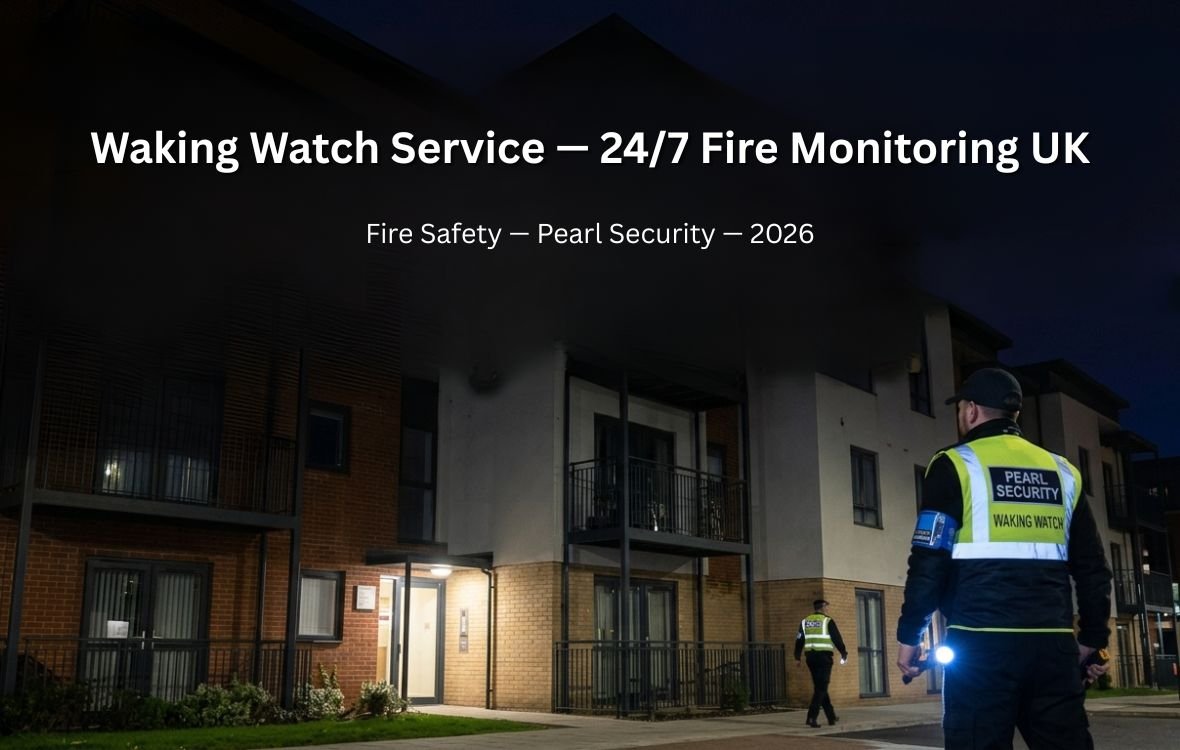
Waking Watch Service UK — What It Is, When You Need It & How It Works (2026)
A waking watch service is a 24-hour continuous human fire monitoring service required in residential buildings with fire safety defects — where the building’s fire alarm system cannot be relied upon to protect residents. Trained waking watch officers patrol the building continuously, alert residents in the event of a fire and maintain fire safety logs. Waking watch services are required under the Fire Safety Act 2021 and Building Safety Act 2022 when fire alarm systems are non-compliant or absent. Pearl Security provides professional waking watch services across Sheffield, Barnsley, Rotherham, Doncaster and Leeds. Call +44 (0) 7481 153593 for a same-day consultation.
Waking watch services in the UK are governed by the Fire Safety Act 2021, Building Safety Act 2022, Regulatory Reform (Fire Safety) Order 2005 and associated guidance from the National Fire Chiefs Council (NFCC). Pearl Security waking watch operatives are trained in fire safety awareness, emergency procedures and resident communication. SIA Licence: 1014558216157759. Company No: 16175087. ICO: ZB986751. Registered: 249 Barnsley Road, Sheffield, S4 7AD.
The Grenfell Tower fire of June 2017 changed everything about how the UK approaches residential fire safety. In its aftermath, thousands of residential buildings across the UK were found to have fire safety defects — inadequate cladding, missing fire breaks, non-compliant compartmentation and alarm systems that could not be relied upon to protect residents. For many of these buildings, a waking watch service became the immediate, legally required response while longer-term remediation was planned and funded.
This guide explains what a waking watch service is, which buildings require it, what the law says, how long it typically lasts and what building owners, residents and managing agents across South Yorkshire and the UK need to know before appointing a waking watch provider.
What is a Waking Watch Service?
A waking watch — also called a waking watch patrol or fire watch — is a 24-hour continuous human monitoring service deployed in residential buildings where the existing fire detection and alarm system is insufficient to safely alert all residents to a fire. Rather than relying on an automated alarm system, trained waking watch officers physically patrol the building around the clock — monitoring for signs of fire, raising the alarm manually and evacuating residents if required.
The term comes from the maritime tradition of keeping a continuous watch — someone is always awake, always monitoring, never leaving the building unobserved. In the context of UK residential fire safety, it means exactly that: a trained person is in the building at all times, actively monitoring for fire risk.
A waking watch is not a permanent solution. It is a temporary interim measure — implemented while remediation works are completed, fire alarm systems are upgraded or a building’s fire safety compliance is restored. The National Fire Chiefs Council (NFCC) is clear that waking watch services should be replaced by a common fire alarm system as soon as practicable.
Why is a Waking Watch Required?
A waking watch service is typically required in residential buildings in one or more of the following circumstances:
- External cladding defects — buildings with unsafe cladding systems, including ACM (aluminium composite material) cladding, HPL (high-pressure laminate) cladding or other non-compliant external wall systems
- Missing or inadequate fire breaks — buildings where fire compartmentation is defective, allowing fire to spread between flats or floors
- Absent or non-compliant fire alarm systems — buildings where there is no common fire alarm system capable of alerting all residents simultaneously
- Fire risk assessment failure — buildings where a fire risk assessment under the Regulatory Reform (Fire Safety) Order 2005 has identified a risk level that cannot be managed without interim human monitoring
- Fire service direction — where the local fire and rescue service has issued a direction requiring interim measures pending remediation
UK Context — Building Safety Crisis: Following the Grenfell Tower fire, the UK government’s Building Safety Programme identified thousands of residential buildings with fire safety defects. As of 2026, significant numbers of buildings across the UK — including in South Yorkshire — remain in remediation programmes. Waking watch services have been deployed across many of these buildings as interim protection while cladding replacement and fire safety works are completed.
What Does a Waking Watch Officer Do?
A professional waking watch officer carries out the following duties continuously throughout every shift:
- Continuous patrol of the building — all floors, stairwells, communal areas and plant rooms covered on a regular rotation throughout the shift
- Fire detection monitoring — actively looking for signs of smoke, fire or unusual heat at all times
- Immediate fire alarm raising — sounding the alarm and evacuating residents at the first sign of fire, without waiting for automated systems to activate
- Resident communication — informing residents of any fire safety concerns and providing reassurance during the waking watch period
- Fire safety log maintenance — completing detailed patrol logs recording times, areas covered and any observations after every patrol circuit
- Emergency services liaison — contacting the fire and rescue service immediately on confirmation of any fire or fire safety concern
- Hot works monitoring — where permitted, monitoring any daytime maintenance or construction works that create fire risk within the building
- Visitor and contractor access management — controlling building access during the waking watch period
UK Legal Framework — Waking Watch Services
Regulatory Reform (Fire Safety) Order 2005
The Regulatory Reform (Fire Safety) Order 2005 places responsibility on the Responsible Person — typically the building owner, freeholder or managing agent — for fire safety in the common parts of residential buildings. Where a fire risk assessment identifies inadequate protection, the Responsible Person must implement interim measures — which may include a waking watch service — until compliant fire safety systems are in place.
Fire Safety Act 2021
The Fire Safety Act 2021 clarified and extended fire safety obligations for multi-occupied residential buildings — specifically confirming that the external walls, cladding, balconies and flat entrance doors of a building fall within the scope of the Responsible Person’s fire safety duties. This clarification directly increased the number of buildings requiring interim fire safety measures including waking watch services.
Building Safety Act 2022
The Building Safety Act 2022 introduced a comprehensive new regulatory framework for higher-risk buildings — defined as residential buildings of 18 metres or more in height (or 7 or more storeys) with at least two residential units. The Act introduced the role of the Building Safety Manager and established new obligations for Accountable Persons — with direct implications for buildings requiring waking watch services pending remediation.
National Fire Chiefs Council (NFCC) Waking Watch Guidance
The NFCC has published specific guidance on waking watch services — setting out minimum standards for officer deployment, patrol frequency, log-keeping and resident communication. Pearl Security waking watch services are delivered in accordance with NFCC guidance as the industry benchmark for professional waking watch provision.
How Many Officers Does a Waking Watch Require?
The number of waking watch officers required depends on the specific building — its height, floor plan, number of residential units, stairwell configuration and the fire risk assessment findings. As a general guide:
| Building Type | Typical Officer Requirement |
|---|---|
| Low-rise block — up to 4 floors, single stairwell | 1 officer per shift |
| Medium-rise block — 5 to 11 floors, single or twin stairwell | 1 to 2 officers per shift |
| High-rise block — 12 floors and above, multiple stairwells | 2 to 4 officers per shift depending on configuration |
| Complex mixed-use development | Risk assessment determines requirement — typically 2+ officers |
Pearl Security conducts a building-specific assessment before deploying any waking watch service — ensuring the officer numbers, patrol routes and shift patterns are appropriate for the specific building and its fire risk assessment findings.
How Long Does a Waking Watch Last?
A waking watch is a temporary interim measure — it should last only as long as is necessary to implement a compliant fire alarm system or complete the required remediation works. In practice, the duration varies significantly:
- Short-term — weeks to months while a common fire alarm system is designed, procured and installed
- Medium-term — months to a year or more where remediation works involve cladding replacement or significant structural fire safety improvements
- Extended — in some cases, waking watch services have continued for multiple years where remediation funding is disputed or works are complex
The Waking Watch Relief Fund — originally established by the UK government in 2021 — provided funding for eligible buildings to install common fire alarm systems as an alternative to ongoing waking watch costs. Building owners and managing agents should check current government guidance on available funding streams for fire safety remediation.
⚠️ Resident Rights: Residents in buildings subject to waking watch services have the right to be informed about the fire safety issues affecting their building, the interim measures in place and the remediation timeline. Building owners and managing agents have obligations under the Building Safety Act 2022 to communicate transparently with residents about building safety matters. Pearl Security waking watch teams are trained to support positive resident communication throughout the service period.
Waking Watch Service — South Yorkshire Coverage
Pearl Security provides professional waking watch services across South Yorkshire and the East Midlands — including residential blocks in Sheffield, Rotherham, Barnsley, Doncaster and Leeds that remain in remediation programmes following fire safety assessments.
- Waking watch Sheffield — residential blocks across all Sheffield postcodes. See our Sheffield security page.
- Waking watch Rotherham — residential developments across Rotherham borough. See our Rotherham security page.
- Waking watch Barnsley — residential blocks across the Barnsley borough. See our Barnsley security page.
- Waking watch Doncaster — residential developments across Doncaster. See our Doncaster security page.
- Waking watch Leeds — residential blocks across Leeds and West Yorkshire. See our Leeds security page.
✅ Professional Waking Watch Services — Pearl Security: Pearl Security provides NFCC-compliant waking watch services across Sheffield, Barnsley, Rotherham, Doncaster and Leeds — continuous 24/7 patrol, detailed fire safety logs, resident communication and emergency services liaison. SIA-licensed officers trained in fire safety awareness. Call +44 (0) 7481 153593 for a same-day waking watch consultation.
Waking Watch Services — Sheffield & South Yorkshire
Pearl Security provides professional, NFCC-compliant waking watch services across Sheffield, Barnsley, Rotherham, Doncaster and Leeds. Same-day consultation available.
FAQs — Waking Watch Service UK
What is a waking watch service?
A waking watch service is a 24-hour continuous human fire monitoring service deployed in residential buildings with fire safety defects — where the fire alarm system cannot be relied upon. Trained officers patrol the building continuously, alert residents to any fire and maintain detailed safety logs throughout every shift.
When is a waking watch legally required?
A waking watch is required when a fire risk assessment under the Regulatory Reform (Fire Safety) Order 2005 identifies that a building’s fire safety measures are inadequate — typically due to cladding defects, missing fire breaks or absent fire alarm systems. The fire and rescue service may also direct a waking watch service where they identify an immediate risk.
How much does a waking watch service cost?
Waking watch costs depend on the number of officers required, shift patterns and building complexity. Pearl Security provides building-specific quotes based on a site assessment. Contact us at +44 (0) 7481 153593 for a same-day consultation and quotation.
How long does a waking watch last?
A waking watch is a temporary interim measure — lasting until a compliant common fire alarm system is installed or required remediation works are completed. Duration ranges from weeks to years depending on the complexity of the remediation required and funding availability.
Do waking watch officers need SIA licences?
SIA licensing is not a specific statutory requirement for waking watch operatives in the same way it is for security guarding roles. However, Pearl Security deploys SIA-licensed officers on all waking watch services — providing an additional layer of professional accountability and compliance assurance for building owners and managing agents.
What is the difference between a waking watch and a fire watch?
Waking watch and fire watch are terms used interchangeably in the UK for the same service — continuous 24-hour human monitoring of a building for fire risk. The term waking watch is more commonly used in the context of residential building safety remediation following the Grenfell Tower fire.