Key Holding Procedures UK — Complete Step-by-Step Guide (2026)
Key holding procedures are the documented operational protocols a professional security company follows when holding your keys and responding to alarm activations — covering secure key storage, alarm response, premises inspection, emergency services liaison and written incident reporting. All governed by the Private Security Industry Act 2001, BS 7858:2019 and UK GDPR. Pearl Security follows fully documented key holding procedures across Sheffield, Barnsley, Rotherham, Doncaster, Leeds and Nottingham. Call +44 (0) 7481 153593 to discuss your requirements.
Pearl Security operates in full compliance with the Private Security Industry Act 2001. All key holding operatives hold current, valid SIA licences verified before each deployment. All personnel vetted to BS 7858:2019. Keys stored in full compliance with UK GDPR / Data Protection Act 2018. SIA Licence: 1014558216157759. Company No: 16175087 (Ya-Fatahoo Solutions Limited). Registered: 249 Barnsley Road, Sheffield, S4 7AD.
Most business owners who use a key holding service have only a vague idea of what actually happens when their alarm activates at 2am. Who gets called? How quickly does someone attend? What do they do on arrival? What happens if there has been a break-in? These questions are not abstract — they determine whether your key holding service is genuinely protecting your business or simply providing false reassurance.
This guide covers professional key holding procedures in full — the complete process from secure key receipt through to post-incident reporting — based on the documented standards Pearl Security follows across Sheffield, Barnsley, Rotherham, Doncaster, Leeds and Nottingham. Understanding these procedures is essential for evaluating any key holding company before handing over your keys.
What Are Key Holding Procedures?
Key holding procedures are the documented operational protocols governing how a professional security company receives, stores and manages your keys — and how they respond when your alarm activates. They are not optional. Professional key holding procedures are essential for insurance compliance, SIA regulatory compliance and the genuine operational effectiveness of the service.
In the UK, key holding companies operate under the Private Security Industry Act 2001. The industry benchmark for key holding procedures is set by the British Security Industry Association (BSIA) and aligns with BS 7858:2019 vetting requirements and UK GDPR / Data Protection Act 2018 data handling obligations. Any professional keyholding company should be able to provide documented evidence of their procedures before you sign any contract.
Complete Key Holding Procedures — Step by Step
- 1Client Onboarding & Formal Key Receipt
When a business appoints Pearl Security as their key holder, a formal key receipt process begins. Keys are collected from the client or handed over in person — never posted or left in unsecured locations. A formal key receipt document is signed by both parties, confirming the number of keys, date of receipt and identity of the handover contact. This document starts the key holding audit trail. - 2Secure Key Storage — UK GDPR Compliant
Keys are stored in a secure, access-controlled location. Critically — and this is a requirement under UK GDPR and the Data Protection Act 2018 — no identifying information is attached to or stored with the keys. The key tag contains only a reference code linking to your details in a separate, secured system. If keys are ever lost or stolen, they cannot be matched to your premises address by a third party. - 3Alarm Receiving Centre (ARC) Registration
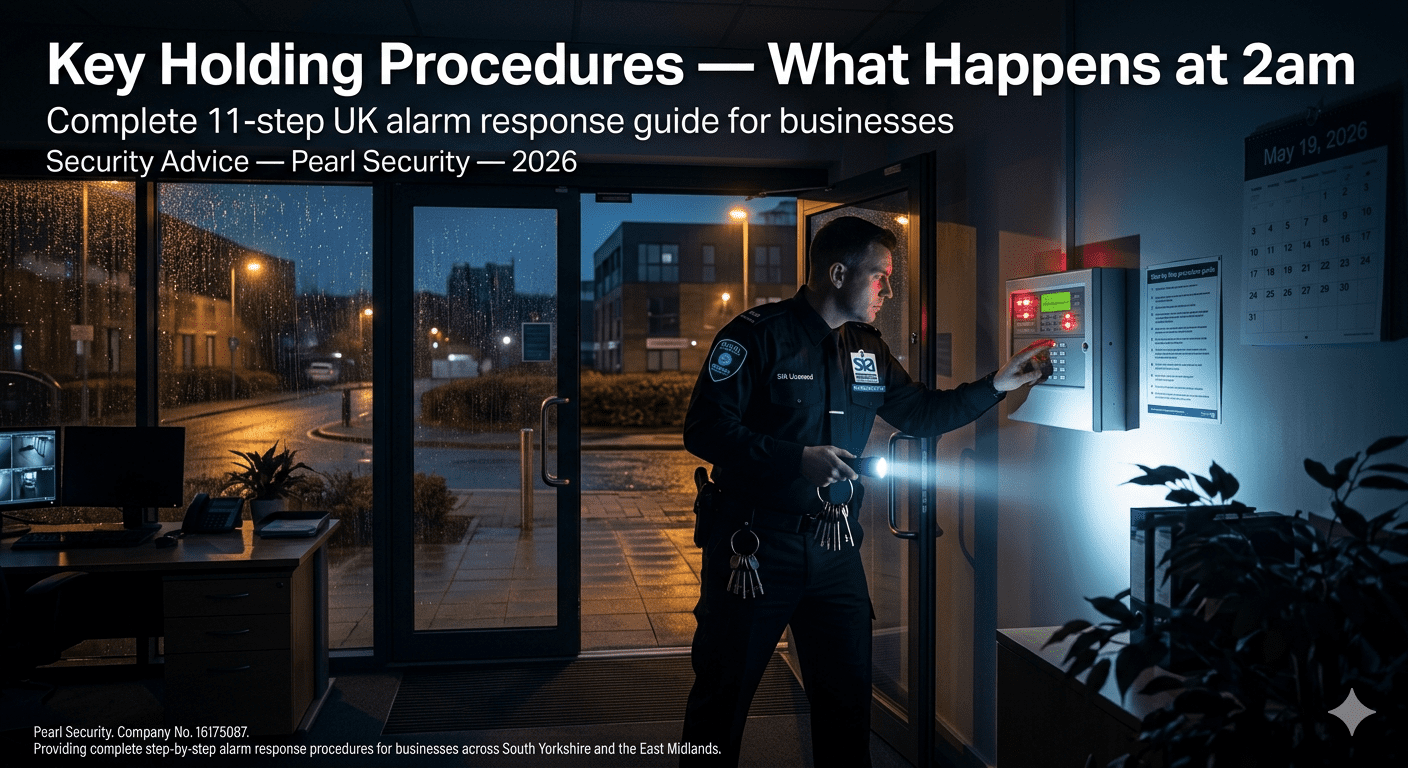
Your alarm monitoring company — or alarm receiving centre (ARC) — is provided with Pearl Security’s 24/7 response contact number. When your alarm activates, the ARC contacts Pearl Security immediately. This is the trigger point for the full alarm response procedure. Confirm with your ARC that our contact details are correctly logged before the key holding service goes live. - 4Alarm Activation — Initial Assessment
When Pearl Security receives an alarm activation from the ARC, the duty officer logs the time, premises address, zone triggered and any prior activation history. This initial assessment determines the appropriate response level and whether police attendance should be requested simultaneously under Police Reform Act 2002 protocols. - 5Deployment of SIA-Licensed Response Officer
A Pearl Security SIA-licensed alarm response officer deploys immediately to your premises. Pearl Security covers Sheffield, Barnsley, Rotherham, Doncaster, Leeds and Nottingham with response officers positioned across South Yorkshire and the East Midlands to minimise attendance times across all coverage areas. - 6External Premises Inspection — Before Entry
On arrival, the response officer does not immediately enter. The correct key holding procedure is an external inspection first — checking all visible entry points (doors, windows, roller shutters, roof lights) for signs of forced entry or suspicious activity before using the keys. This protects the officer and preserves forensic evidence in the event of a genuine break-in. - 7Internal Inspection & Alarm Investigation
If the external inspection reveals no forced entry, the officer enters, disarms the alarm and conducts a full internal inspection — checking every room, storage area and access point. The cause of activation is identified: genuine intruder activity, false alarm (environmental trigger, equipment fault, animal activation) or system fault. - 8Emergency Services Liaison
If a break-in, fire, medical emergency or other incident is identified, the response officer contacts the appropriate emergency service immediately and remains on site to assist. Under the Police Reform Act 2002, the officer liaises directly with attending officers, provides a witness account and secures the scene where required. - 9Premises Secured
Once inspection and emergency response are complete, the officer secures the premises — locking all access points, resetting or placing the alarm in engineer mode as appropriate, and noting any damage. If the premises cannot be secured due to forced entry damage, the client is notified immediately and emergency boarding is recommended. - 10Client Notification
Pearl Security contacts the client directly — at any time of day or night — to report the outcome. Notification covers: time of activation, time of officer arrival, cause of activation, actions taken, whether emergency services attended and the current security status of the premises. No client is left uninformed after an alarm activation. - 11Written Incident Report
A full written incident report is completed after every alarm response — regardless of whether it was a genuine incident or a false alarm. The report includes date and time of activation, officer attendance time, external and internal inspection findings, cause of activation, actions taken, emergency services involvement and officer signature. Essential for insurance purposes and your own security records.
Key Holding Procedures — Insurance Compliance Requirements
Professional key holding procedures directly affect your commercial insurance policy. Most UK commercial insurers require that any key holding arrangement meets these minimum professional standards:
- Keys held by a company with SIA-licensed operatives — verified at sia.homeoffice.gov.uk
- No identifying information stored with or attached to keys
- 24/7 alarm response capability confirmed in writing
- Written incident reports provided after every activation
- Formal key receipt and audit trail documentation maintained
- Public liability insurance held by the key holding company
⚠️ Insurance Warning: Using an unlicensed individual — a staff member, family member or unlicensed operative — as your key holder may invalidate your commercial insurance in the event of a break-in. Always confirm your insurer’s key holding requirements before appointing any key holder. Pearl Security’s key holding service meets the requirements of all major UK commercial insurers.
Key Storage Procedures — What UK Law Requires
UK GDPR & Data Protection Act 2018
Your keys represent access to your premises — and your premises address is commercial data subject to UK GDPR. Keys must be stored with reference codes only, physically separated from any data linking them to your address. Pearl Security stores all client keys with reference codes only — your business details are held in a separate, access-controlled system never co-located with the physical keys.
Private Security Industry Act 2001
Every operative accessing client keys and attending premises in a professional security capacity must hold a valid SIA licence. This applies to every person in the chain — from key receipt at onboarding to alarm response at 3am. Pearl Security SIA Licence: 1014558216157759.
Questions to Ask Any Key Holding Company
- Are all response officers SIA licensed? Provide licence numbers for verification
- How are keys stored — physically separated from identifying information?
- What is your documented alarm response procedure?
- Do you conduct an external inspection before entering premises?
- How quickly do you notify clients after an activation?
- Do you provide written incident reports after every response?
- How is your key receipt and audit trail documented?
- Are you UK GDPR compliant regarding key and client data storage?
- Do you carry public liability insurance?
Key Holding Services — Pearl Security Coverage
Pearl Security provides professional key holding services with fully documented procedures across:
- Key holding Sheffield — all Sheffield postcodes S1–S36. See Sheffield security page.
- Key holding Barnsley — full borough coverage. See Barnsley security page.
- Key holding Rotherham — Parkgate, Maltby, Wickersley, AMP Waverley. See Rotherham security page.
- Key holding Doncaster — iPort, Frenchgate and all areas. See Doncaster security page.
- Key holding Leeds — city centre and all West Yorkshire. See Leeds security page.
- Key holding East Midlands — Nottingham and surrounding areas. See Nottingham security page.
✅ Documented Key Holding Procedures — Pearl Security: Pearl Security follows fully documented, SIA-compliant key holding procedures — written incident reports after every activation, GDPR-compliant key storage, 24/7 SIA-licensed alarm response. Call +44 (0) 7481 153593 or request a free consultation.
Professional Key Holding — Sheffield & South Yorkshire
Pearl Security provides documented, SIA-compliant key holding across Sheffield, Barnsley, Rotherham, Doncaster, Leeds and Nottingham. Free, no-obligation consultation available.
FAQs — Key Holding Procedures UK
What are key holding procedures?
Key holding procedures are the documented protocols covering secure key storage, alarm response attendance, premises inspection, emergency services liaison and incident reporting. Read our full guide: What is Key Holding? Complete UK Guide.
What is a key holder policy?
A key holder policy is your organisation’s documented approach to managing premises access — defining who holds keys, how they are stored, who responds to alarm activations and what procedures are followed. Pearl Security provides professional delivery of your key holder policy across South Yorkshire and the East Midlands.
What SIA licence is required for key holding in the UK?
All commercial key holding and alarm response operatives must hold a valid SIA Security Guard licence under the Private Security Industry Act 2001. Verify at sia.homeoffice.gov.uk. Pearl Security SIA Licence: 1014558216157759.
How should a key holding company store keys legally?
Under UK GDPR and the Data Protection Act 2018, keys must be stored with reference codes only — never with identifying information linking them to your premises. Pearl Security stores all client keys to this standard across all operations.
What happens when a key holding company responds to an alarm?
Professional alarm response follows: external inspection before entry, full internal premises inspection, cause identification, emergency services liaison where required, premises secured, client notified and written incident report submitted. See our complete step-by-step guide above or our key holding page.
Do key holding procedures differ between UK, USA and Australia?
Core alarm response procedures are similar globally — external inspection, internal check, emergency services liaison, incident reporting. The regulatory difference is licensing: UK requires SIA licensing under the Private Security Industry Act 2001. Australia requires state-based security licensing. USA has state-level requirements that vary significantly. Canada and New Zealand operate similar provincial and national licensing frameworks.