Security Officer Duties & Responsibilities UK — Complete Job Role Guide (2026)
A UK security officer’s core duties include access control, perimeter patrol, CCTV monitoring, incident response, lock and unlock, alarm response, report writing and emergency services liaison. All commercial security officers must hold a valid SIA Security Guard licence under the Private Security Industry Act 2001. Responsibilities vary by deployment — a retail security officer, construction site guard and key holding officer each carry distinct duties shaped by their environment and the specific contract. Pearl Security deploys directly employed, SIA-licensed security officers across Sheffield, Barnsley, Rotherham, Doncaster, Leeds and Nottingham. Call +44 (0) 7481 153593 for a free consultation.
All Pearl Security officers hold current, valid SIA licences verified before every deployment. All personnel vetted to BS 7858:2019. ICO Registered: ZB986751. SIA Licence: 1014558216157759. Company No: 16175087. Registered: 249 Barnsley Road, Sheffield, S4 7AD.
When businesses hire a security company, they often have only a vague idea of what the officer they are paying for actually does during a shift. A security officer who simply stands at a door and looks official is not providing professional security — they are providing presence. The difference between presence and professional security is significant, and it shows up when something goes wrong.
This guide sets out the full range of security officer duties and responsibilities in the UK — what a properly deployed, SIA-licensed security officer does, what they are legally permitted to do, what falls outside their authority and how their responsibilities differ across the main deployment types. Whether you are a business evaluating a security proposal, an aspiring security professional or an international reader understanding UK security standards, this guide covers everything.
The Role of a Security Officer in the UK
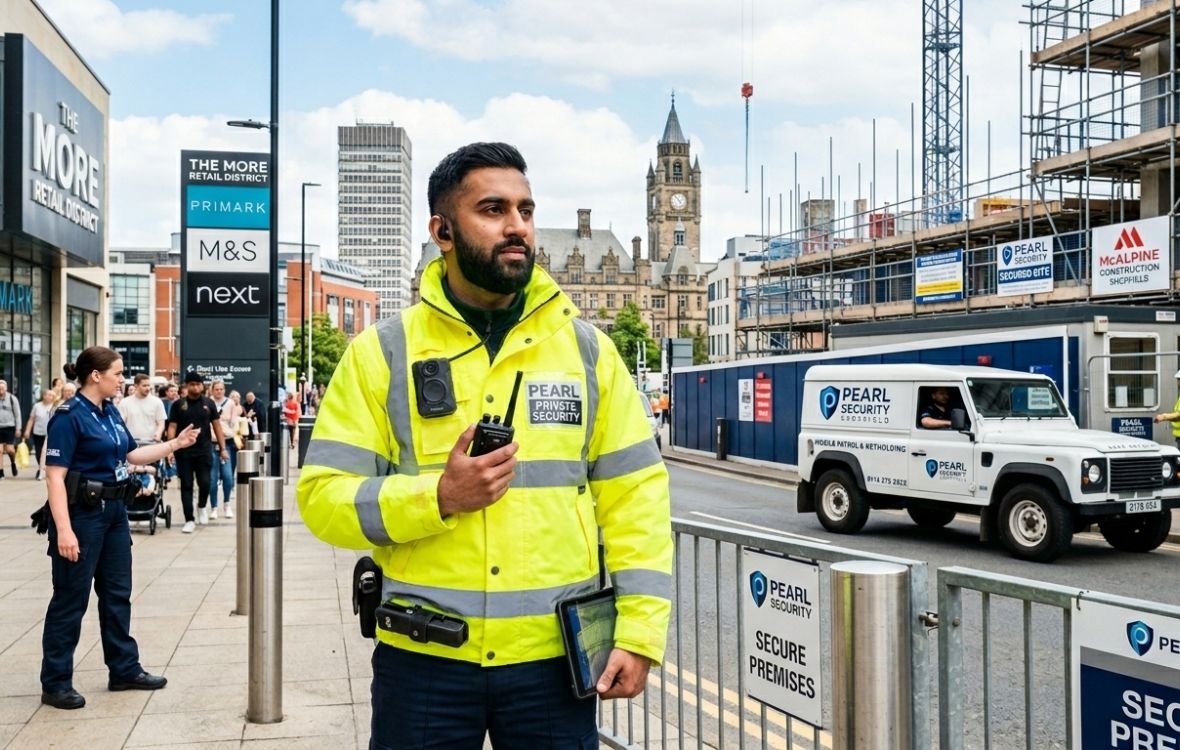
A professional security officer in the UK is a trained, SIA-licensed operative whose role is to protect people, property and assets through deterrence, observation, access control and incident response. The role is more demanding than it appears from the outside — requiring sound judgement, composure under pressure, clear communication, physical presence and an understanding of the legal boundaries within which security officers operate.
Security officers in the UK do not have police powers. They have the same legal authority as any member of the public — plus specific rights and responsibilities that arise from the context of their role and the Private Security Industry Act 2001. Understanding this distinction is essential both for security officers and for the businesses that employ them.
Core Security Officer Duties — UK Standard
1. Access Control
Managing who enters and exits the premises is one of the most fundamental security officer duties. Access control involves checking credentials and identification, issuing visitor passes, maintaining accurate entry and exit logs, refusing access to unauthorised individuals and managing vehicle access where relevant. Effective access control directly reduces the risk of theft, vandalism, unauthorised occupation and health and safety incidents caused by unvetted visitors on site.
2. Perimeter and Premises Patrol
Regular, documented patrol of the building perimeter and internal areas — checking doors, windows, gates, access points and high-risk areas on a set schedule. Patrols should be varied in timing and route to prevent predictability. Every patrol is recorded in the shift log — noting the time, areas covered and any observations. For large or complex sites, patrol routes are agreed with the client during the site assessment process.
3. CCTV Monitoring
Where a CCTV system is present, security officers may be required to monitor live feeds, identify incidents in real time and respond or escalate as appropriate. Officers monitoring public-facing CCTV systems in the UK must hold a separate SIA CCTV Licence under the Private Security Industry Act 2001. Pearl Security confirms the correct licence type for every deployment before any officer begins work.
4. Incident Detection and Response
Identifying and responding to security incidents — theft, vandalism, trespass, fire, medical emergency, confrontation — is a core security officer responsibility. Professional incident response involves assessing the situation, taking appropriate action within legal authority, contacting emergency services where required and ensuring the safety of all persons on the premises. Every incident is documented in full in a written incident report submitted after the shift.
5. Conflict Management and De-escalation
Security officers regularly encounter confrontational situations — aggressive visitors, trespassers, shoplifters, intoxicated individuals and disputes between third parties. Professional conflict management means de-escalating these situations verbally, maintaining composure and protecting the safety of all involved. Pearl Security trains all officers in conflict management before deployment — and makes clear that physical intervention is a last resort, not a first response.
6. Lock and Unlock Service
Opening and securing premises at agreed times — checking all areas are clear before locking, setting alarms correctly and submitting timestamped visit reports. See our full guide: Lock and Unlock Service UK.
7. Alarm Response
Attending premises when an intruder alarm activates — conducting an external inspection before entry, completing a full internal premises check, liaising with emergency services where required and securing the building. A written incident report is submitted after every alarm response attendance. See our full guide: Alarm Response Services UK.
8. Fire Safety Awareness and Response
Security officers must be briefed on fire alarm locations, evacuation assembly points and emergency procedures for every site on which they are deployed. In the event of a fire alarm activation, the officer’s immediate responsibility is to initiate evacuation, contact emergency services and assist with the safe egress of all persons from the building. Officers deployed as part of a waking watch service carry additional fire monitoring responsibilities.
9. Report Writing and Shift Logs
Accurate, detailed written records are one of the most important security officer duties — and one of the most frequently undervalued. Shift logs record patrol times, access control events, incidents, observations and any deviations from the agreed service specification. Incident reports provide a documented account of every security event — essential for insurance claims, police investigations and client records. Pearl Security submits written reports after every deployment as standard.
10. Customer Service and Visitor Management
Security officers represent the first point of contact for many visitors to commercial premises. Professional presentation, courteous communication and helpful visitor management are as important as any physical security duty — particularly in retail, corporate office and hospitality environments. A security officer who is surly, dismissive or unhelpful creates a poor first impression that reflects on the client business, not just the security company.
Security Officer Legal Powers — What They Can and Cannot Do
Understanding the legal authority of a UK security officer is essential — both for officers and for the businesses that hire them. Security officers do not have police powers. They operate within the same legal framework as any member of the public, with specific rights arising from their role:
| Action | Security Officer Authority | Legal Basis |
|---|---|---|
| Citizen’s arrest | ✅ Yes — under specific circumstances | Section 24A PACE 1984 — reasonable grounds to believe indictable offence committed |
| Refusing entry to private premises | ✅ Yes — as agent of the occupier | Common law right of occupier to control access to private property |
| Detaining a shoplifter | ✅ Yes — with reasonable grounds | Section 24A PACE 1984 — citizen’s arrest powers |
| Searching a person | ⚠️ Only with consent | No legal power to search without consent — any search requires voluntary agreement |
| Use of force | ⚠️ Self-defence only — last resort | Criminal Law Act 1967 — reasonable force in self-defence or defence of another |
| Issuing fixed penalty notices | ❌ No | Police power only — no authority for security officers |
| Stopping vehicles on public roads | ❌ No | Police power only |
⚠️ Equality Act 2010 Compliance: All access control and refusal of entry decisions made by security officers must comply with the Equality Act 2010. Officers cannot refuse entry or treat individuals differently on the basis of any protected characteristic — including age, race, disability, religion, gender or sexual orientation. Pearl Security trains all officers in Equality Act compliance before deployment. Failure to comply exposes your business to significant legal and reputational risk.
Security Officer Responsibilities by Deployment Type
Security officer duties vary significantly depending on the deployment environment. The core competencies remain consistent — but the specific application of those competencies changes with the context:
Retail Security Officer Duties
- Loss prevention — identifying pre-theft behaviour, concealment and organised retail crime patterns
- Customer service — directing customers, maintaining a welcoming environment
- Shoplifter detention — lawful detention under PACE Section 24A with reasonable grounds
- Access control at entrances — bag checks where agreed with client and consented to by customers
- CCTV monitoring — where installed and where officer holds SIA CCTV licence
See our guide: Retail Security Guards Sheffield & Leeds.
Construction Site Security Officer Duties
- Access control — logging all personnel and vehicle movements on and off site
- Plant and equipment monitoring — checking high-value plant is secured at end of shift
- Perimeter patrol — checking fencing, gates and access points throughout the shift
- CDM 2015 compliance — following site-specific rules under Construction Design and Management Regulations
- PPE compliance — hard hat, hi-vis and safety footwear worn at all times on active sites
See our guide: Construction Site Security UK.
Manned Guarding Officer Duties
- Static access control at premises entrance
- Regular internal and external patrol
- Visitor management and signing-in procedures
- CCTV monitoring where required
- Emergency response — fire, medical, security incidents
- Detailed shift log maintenance
See our guide: Manned Guarding Services UK.
Mobile Patrol Officer Duties
- Attending multiple client sites on a randomised schedule throughout the shift
- Checking perimeters, access points and high-risk areas at each site
- Submitting a written patrol report after every site visit
- Responding to alarm activations as directed
See our guide: Mobile Security Patrols Sheffield.
SIA Licence — The Legal Requirement for UK Security Officers
Every security officer working commercially in the UK must hold a valid SIA licence under the Private Security Industry Act 2001. The SIA issues separate licence types for different roles — Security Guard, Door Supervisor, CCTV Operator and Close Protection. Each requires specific training and certification before the licence is issued.
SIA licences are renewed every three years. Licence holders must maintain their training currency and comply with SIA standards to retain their licence. Always verify any officer’s SIA licence before deployment at sia.homeoffice.gov.uk. Pearl Security SIA Licence: 1014558216157759.
Security Officer Duties — UK vs International Comparison
| Country | Licensing Body | Arrest Powers | Search Powers |
|---|---|---|---|
| UK | Security Industry Authority (SIA) | Citizen’s arrest — Section 24A PACE 1984 | Consent only — no statutory search power |
| USA | State licensing — varies by state | Citizen’s arrest — varies by state | Consent only in most states |
| Australia | State-based licensing | Citizen’s arrest under common law | Limited — consent-based in most states |
| Canada | Provincial licensing | Citizen’s arrest — Criminal Code Section 494 | Consent only |
| New Zealand | Ministry of Justice | Citizen’s arrest — Search and Surveillance Act 2012 | Consent only |
✅ Pearl Security Officers — Trained, Licensed, Accountable: Every Pearl Security officer is SIA-licensed, BS 7858 vetted, conflict-management trained, Equality Act compliant and directly managed by Pearl Security across Sheffield, Barnsley, Rotherham, Doncaster, Leeds and Nottingham. Call +44 (0) 7481 153593 to discuss your security requirements.
Hire Professional Security Officers — South Yorkshire & East Midlands
Pearl Security provides directly employed, SIA-licensed security officers across Sheffield, Barnsley, Rotherham, Doncaster, Leeds and Nottingham. Free site assessment — no obligation.
FAQs — Security Officer Duties UK
What are the main duties of a security officer in the UK?
Core UK security officer duties include access control, perimeter patrol, CCTV monitoring, incident response, conflict management, lock and unlock, alarm response, fire safety awareness and detailed report writing. Specific duties vary by deployment type — retail, construction, manned guarding and mobile patrol each carry distinct responsibilities.
Can a UK security officer arrest someone?
Yes — a UK security officer has the same citizen’s arrest powers as any member of the public under Section 24A of the Police and Criminal Evidence Act 1984. They can detain a person they have reasonable grounds to believe has committed an indictable offence — such as theft. They do not have general police powers of arrest.
Can a security officer search someone in the UK?
A UK security officer has no statutory power to search a person. Any search requires the voluntary consent of the individual. Bag searches at retail entrances are permissible only where customers voluntarily consent — typically signposted at the entrance. Pearl Security trains all officers in lawful search procedures before deployment.
What SIA licence does a security officer need in the UK?
Security officers providing commercial guarding services require an SIA Security Guard licence. Door supervisors at licensed premises require an SIA Door Supervisor licence. Officers monitoring public-facing CCTV require an SIA CCTV Licence. All licences are issued under the Private Security Industry Act 2001 and verified at sia.homeoffice.gov.uk.
What is the difference between a security guard and a security officer?
In UK practice, security guard and security officer refer to the same role — a professionally trained, SIA-licensed operative providing commercial security services. The term security officer is increasingly preferred within the industry as it more accurately reflects the professional, trained nature of the role. Both terms describe the same SIA-licensed position under the Private Security Industry Act 2001.